
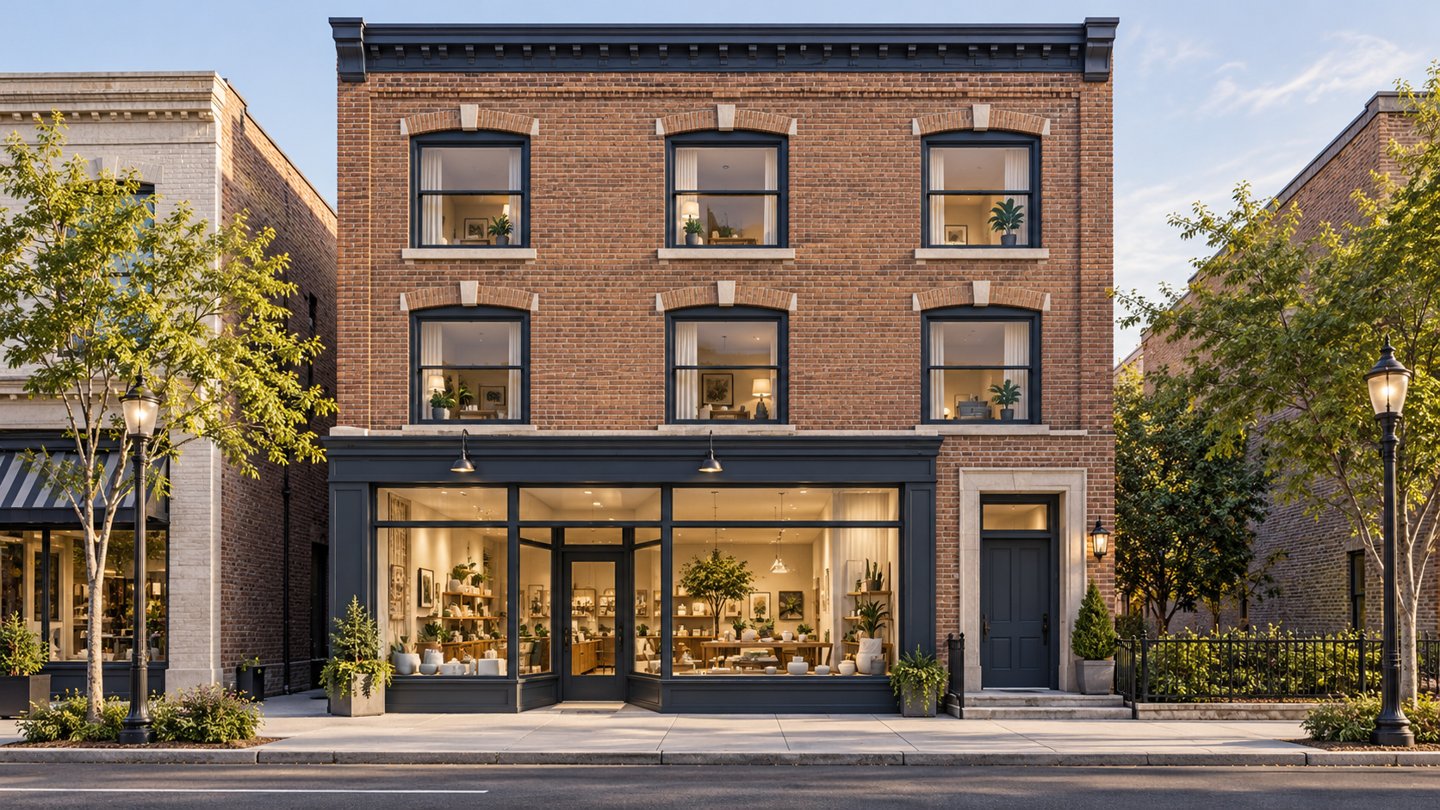
A mixed use DSCR loan finances an eligible building that combines residential rental space with commercial space, such as apartments above a storefront. The lender assesses both the property's operating cash flow and the mix of uses. A building can pass a coverage calculation and still fail a program's property-eligibility rules.
This guide separates square footage, income concentration and debt coverage, then combines them in an editable calculator. The Main Street example is hypothetical. Its interest rate, coverage target and LTV cap are calculation inputs, not current loan offers or statutory thresholds.
What Qualifies as Mixed-Use in Non-QM Underwriting?
A storefront with apartments is an obvious mixed-use property, but the label doesn't identify the right loan. Ask whether the lender accepts the exact legal unit count, commercial activity, occupancy and ownership structure. A residential investor program that accepts four rental units may exclude any commercial space.
“Non-QM” is a marketing term often associated with residential financing outside qualified-mortgage standards. It isn't a single commercial underwriting system. A mixed-use business-purpose loan may be offered through a bank, commercial lender or specialist investor program, each with different documentation and collateral rules. Don't treat the term as a promise that tax returns or guarantees will never be requested.
The Fannie Mae single-family mixed-use eligibility guidance describes a specific situation: a primarily residential one-unit principal residence where the borrower also owns and operates the business. An investor buying a third-party leased shop beneath three rented apartments is a different file. Fannie Mae's separate multifamily business has its own programs and requirements.
Commercial options do exist. Axos Bank's small-balance commercial lending page explicitly describes apartment/retail mixed-use financing. That establishes a potential funding channel, not approval of your property or a published universal rate. Ask for a dated fit review before paying for valuation reports.
Start that review with zoning and lawful use. Compare the rent roll, floor plans, certificates and appraisal description. A space marketed as an apartment may legally be storage or office space. If approval depends on converting it, distinguish current eligibility from a future renovation plan. Our DSCR loan fundamentals guide explains the income definitions to confirm alongside those property facts.
The “51% Rule”: Residential vs Commercial Square Footage
There is no universal rule that 51% residential floor area guarantees a mixed-use DSCR loan. A lender can set a residential-area minimum, a commercial-area maximum, an income limit or several tests together. The denominator and measurement method matter as much as the percentage.
Consider a building with 2,400 residential rentable square feet and a 1,200-square-foot shop. Residential space is 66.67% of the 3,600-square-foot total. That clears an entered 51% residential-area screen. It doesn't establish zoning compliance, acceptable tenant use or sufficient coverage. Nor does it show whether stairways, basements and common areas belong in the lender's measurement.
The frequently cited SBA 51% test concerns the operating business's occupancy of an existing building. It isn't a residential-apartment percentage test. 13 CFR 120.131 addresses that owner-business occupancy framework, with different conditions for new construction. Have an SBA lender confirm current applicability if your own business will occupy the building; don't copy that rule into an investment-property DSCR screen.
Space share and rent share can disagree
A 1,200-square-foot shop can produce 45% of a building's rent while occupying only one-third of its rentable space. A lender concerned about commercial tenant concentration may reject a file that comfortably passes the area test. Calculate both shares before describing the property as “mostly residential.”
Our calculator compares residential area with an entered minimum and commercial scheduled rent with an entered maximum share. Those are independent scenario screens. Results don't certify that a lender accepts either test, and they don't substitute for the lender's appraisal measurements or qualifying-income method.
Mixed-Use Space and Income Ratio Qualification Calculator
Enter supported apartment rent and commercial base rent separately. Apply different vacancy and collection-loss assumptions to each. Add collectible expense reimbursements separately, then deduct the full operating expenses those reimbursements relate to. The model reports cash flow and the assumptions that drive its sizing limits.
Mixed-Use Space & Income Ratio Qualification Calculator
Area and commercial-rent thresholds are entered screens, not universal rules. Expenses must include the full costs associated with reimbursements.
Use a new scenario when a lease changes. The local save function retains inputs only in this browser; CSV export creates a values-only record you can open in Excel. Don't enter tenant names or account details. The calculator doesn't send financial statements to us or to a lender.
The income-share screen uses scheduled base rents before vacancy and excludes reimbursements. Coverage uses effective income after the entered vacancy assumptions, plus reimbursements, less expenses and a separately entered replacement reserve. That difference is intentional and labeled. Ask whether your lender uses another basis before comparing its ratio with this model.
Commercial Lease Terms: NNN Leases vs Gross Leases
A gross lease generally places more property expenses with the landlord, while a net lease can shift defined expenses to the tenant through reimbursements. The lease wording controls. “NNN” doesn't guarantee that every tax, insurance, maintenance or capital expense will be reimbursed in full and collected on time.
Suppose the shop pays $24,000 annual base rent and $6,000 in collectible reimbursements. If the landlord incurs $10,000 of related property expenses, show $30,000 of revenue and the full $10,000 expense. Recording the reimbursements while deducting only the unreimbursed $4,000 would overstate income by $6,000.
Review expense stops, caps, exclusions and reconciliation periods. A tenant may reimburse routine maintenance but not a roof replacement. A fixed monthly estimate can still require a year-end true-up. Read the lease and collection records together so your operating budget reflects both the contractual claim and the expected cash receipts.
Lease expiry is a financing input
A five-year mortgage term doesn't mean a commercial tenant will remain for five years. Record the remaining firm lease term, renewal options, termination rights and rent steps. A tenant-controlled renewal option is different from a signed extension. Evaluate the cost and delay of replacing the tenant if the option isn't exercised.
Tenant improvements and leasing commissions can be large cash items even when recurring NOI looks healthy. Model them outside ordinary operating expenses where appropriate, and include them in your acquisition and rollover budget. An empty shop can require months of carrying costs before the next tenant begins paying full rent.
For a more detailed explanation of lender cash-flow adjustments, use the commercial DSCR underwriting guide. Its T12 and reserve discussion applies here, although mixed-use eligibility and lease concentration need separate review.
Tenant Quality Checks: Retail Stability vs Apartment Turnover
A commercial lease can provide a longer contractual income stream, but a single shop tenant creates concentration. Three apartments create more leases to manage, yet one apartment vacancy may remove less revenue than the loss of the commercial tenant. Examine the actual dollar contribution rather than assuming one tenant type is safer.
For the shop, check the executed lease, payment history, permitted use, renewal rights and any guaranty. Ask about restrictions on assignment, subletting and changes in business use. A proposed restaurant may create different insurance, ventilation, grease-management and build-out questions from a quiet professional office.
Evaluate apartment collections with equal care. Reconcile leases, arrears, concessions and deposits to the rent roll. A unit marked occupied may still generate less cash than its contract rent. Security deposits don't become recurring rental income simply because the landlord holds them in a bank account.
Stress a specific loss of income
If the shop contributes $2,000 monthly base rent, six months without it removes $12,000 before considering lost reimbursements and reletting costs. A generic 5% vacancy assumption may miss that concentration risk. Run the commercial rent at zero, then test a recovery period with documented carrying costs.
The DSCR stress-testing calculator helps assess broader expense and rent changes. For mixed-use property, supplement a general stress with a tenant-specific scenario. A small shop's failure can affect building insurance, property condition and cash collections together, rather than changing one clean line in a model.
Down Payment and LTV Caps: Testing 70%–75% Scenarios
Treat 70% and 75% LTV as comparison assumptions unless a named lender confirms them for your file. There isn't a universal mixed-use maximum in that range. Commercial concentration, sponsor experience, value, debt yield, DSCR and loan purpose can lead to different proceeds.
For a $350,000 price, 80% financing means $280,000 debt and $70,000 equity before costs. A 75% cap lowers debt to $262,500 and raises purchase equity to $87,500. At 70%, debt is $245,000 and equity is $105,000. Those amounts exclude closing costs, escrows, reserves, repairs and leasing capital.
At an illustrative 7.50% fixed rate and 30-year amortization, the $280,000 payment is $1,957.80 monthly. A smaller loan lowers the payment, but it doesn't change an ineligible use into eligible collateral. Run the property screen and the income sizing separately, then compare the lower of the applicable loan limits.
The DSCR down-payment guide explains why purchase equity isn't the entire cash requirement. For market context, our daily checked rate references identify mortgage benchmarks and lender starting-rate sources. They aren't mixed-use rate quotes. Ask for matched offers with the same balance, amortization, fees and prepayment terms.
Case Study: A Main Street Storefront with Three Loft Apartments
This constructed example assumes legal, separately rentable space and an accepted $650,000 value. There are three apartments producing $3,900 total monthly scheduled rent, plus a shop paying $2,000 monthly base rent. Residential area is 2,400 square feet and commercial area is 1,200 square feet.
Apartment vacancy and collection loss are modeled at 5%; commercial loss is 10%. Add $3,000 of collectible annual reimbursements. Deduct $22,000 of recurring operating expenses, including all taxes, insurance, maintenance and management assumed in this scenario. Deduct another $3,000 as a replacement reserve to reach lender cash flow.
| Underwriting line | Hypothetical result |
|---|---|
| Residential effective annual rent | $44,460.00 |
| Commercial effective annual base rent | $21,600.00 |
| Annual reimbursements | $3,000.00 |
| EGI | $69,060.00 |
| Operating expenses | $22,000.00 |
| NOI | $47,060.00 |
| Replacement reserve | $3,000.00 |
| Lender cash flow | $44,060.00 |
| Annual P&I | $38,177.11 |
| Reserve-adjusted DSCR | 1.1541x |
| DSCR loan cap at 1.25x | $420,090.44 |
Residential area is 66.67%, while commercial base rent is 33.90% of total scheduled base rent. The area share clears an entered 51% minimum, and commercial rent clears an entered 40% maximum. Those are hypothetical screens. A lender using a different threshold or including reimbursements in its concentration test can reach another conclusion.
The $455,000 requested balance is 70% of the assumed value. At 7.50% with 30-year amortization, annual P&I is approximately $38,177.11. Lender cash flow is $44,060, producing about 1.1541x reserve-adjusted coverage. Passing both mix screens hasn't created enough cash flow for an entered 1.25x target.
What changes the outcome?
The DSCR-based loan cap is approximately $420,090 at that rate and target, below the $455,000 value-based limit. Lower proceeds would require additional equity. A higher appraisal alone wouldn't fix the cash-flow constraint, because income rather than LTV controls this scenario.
Now remove all commercial rent while leaving only $0 of reimbursements. The shop vacancy can reduce income much more sharply than the base 10% commercial-loss allowance. Run that downside in the calculator and assess whether your cash reserves can fund operations and debt until the space is relet. Don't assume the apartments automatically carry the whole note.
Appraisal, Environmental and Closing Checks
Ask the lender which commercial appraisal and environmental process applies. Prior site uses, repair obligations, legal unit count and highest-and-best-use analysis can influence value and eligibility. A shop's current appearance doesn't explain whether an earlier business left a problem requiring investigation.
The EPA All Appropriate Inquiries guidance describes the environmental assessment framework; it doesn't certify a particular property. Obtain the lender's required report from an accepted professional. Confirm whether the lender can rely on a report already ordered for another party.
Before removing financing contingencies, reconcile the proposed loan balance with cash to close, repairs, lease rollover and reserves. Review recourse, transfer restrictions and prepayment language with qualified counsel. A useful approval discussion keeps legal eligibility, area mix, income concentration and cash-flow sizing visible as separate issues.
If you are comparing the property with a different commercial use, the self-storage DSCR guide shows a separate approach to occupancy and operating-income review. Do not transfer apartment or retail assumptions to storage units without checking the underlying evidence.
Build a Mixed-Use Quote Request That Can Be Compared
Send each candidate lender the same property description, floor-area schedule, apartment rent roll, commercial lease summary and monthly T12. Identify the source date for every figure. Include the proposed loan amount, purchase price, intended ownership entity and any near-term repair or leasing plan. A consistent package makes differences between quotes easier to explain.
Request confirmation of the accepted commercial use before asking for the lowest rate. Record whether the lender has reviewed the actual lease or is relying on a short summary. A preliminary fit response is useful, but it should not be confused with completed credit, appraisal or legal approval.
When comparing term sheets, keep the assumed income basis visible next to the rate. Two offers can show similar payments while using different rents, reserves or maturity structures. Ask about report costs, escrow funding, lock expiry and conditions that can change proceeds. Preserve the final written terms with the calculator export so an older assumption doesn't quietly become part of the closing budget.
Stress the largest commercial lease separately: If a retail tenant provides 40% of accepted property income, a full vacancy is a concentration event that a general 5% vacancy assumption won’t describe. Model the lost income, owner-paid costs during downtime and a supported re-leasing budget. Keep the residential and commercial expense allocations consistent across the scenarios.
Frequently Asked Questions
Is 51% residential space enough for a mixed-use DSCR loan?
No universal 51% residential rule applies to every mixed-use DSCR loan. A lender can impose area, income-concentration and other property requirements. The SBA owner-business occupancy framework is a different test and should not be copied into an investment-property screen.
Can I finance a storefront with apartments above it?
Potentially, through a lender that explicitly accepts the legal property mix and tenancy. Confirm commercial activity, lawful unit count, sponsor requirements and income treatment before ordering reports. Passing a calculator screen does not establish eligibility or approval.
Does a triple-net lease remove all landlord expenses?
No. The signed lease defines reimbursable costs, caps, exclusions and collection obligations. Record collectible reimbursements as revenue and the full related expenses as costs. Capital work and tenant default can still leave the owner with cash obligations.
Are mixed-use loans always capped at 75% LTV?
No universal cap is assumed here. The 70% and 75% comparisons are scenarios. Available proceeds depend on the lender, collateral, accepted value, income, borrower and terms; DSCR can require a lower balance than the LTV limit permits.
Does the calculator issue a qualification decision?
No. It compares entered area and income screens and calculates income-based and value-based debt limits. It does not verify leases, measurements, zoning, environmental conditions or borrower information. Save and CSV export functions retain a calculation record, not a loan application.
Prepared by Maniteja, investor. Examples and calculator defaults are hypothetical. Sources were checked October 30, 2026. This article supplies educational calculations, not a lender commitment, legal opinion or completed transaction report.
Leave a Reply