

Sources checked October 14, 2026. Linked lender and agency guidance can change. Confirm current eligibility and terms directly before making a financing decision.
A DSCR loan is rental-property financing that uses the property’s income and debt payments as a central qualification measure. DSCR stands for debt service coverage ratio. It helps a lender assess payment coverage, while a DSCR calculator helps you test the numbers before applying. Credit, property value and available cash still matter.
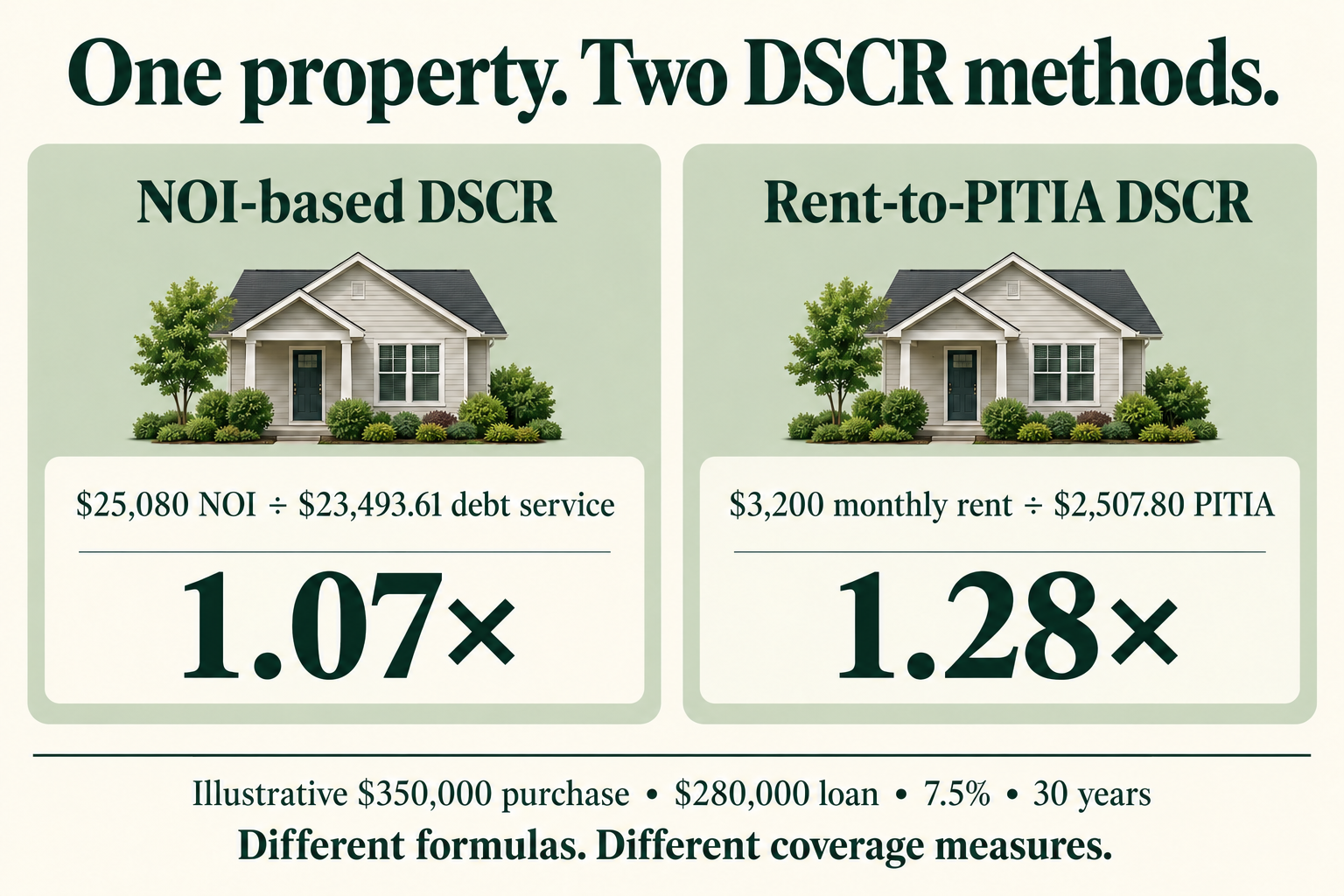
There’s a detail worth checking before you trust any result: which DSCR formula is being used? A residential lender may divide monthly rent by the full housing payment. A commercial property analysis generally divides net operating income by annual debt service. Those calculations can produce noticeably different answers for the same property.
This guide uses an illustrative $350,000 purchase to explain both methods, the questions to ask a lender, and how to test a deal without confusing loan qualification with cash flow.
In this guide
- What DSCR means
- The two DSCR formulas
- A $350,000 rental-property example
- Using the DSCR calculator
- Interpreting a good DSCR
- Loan requirements and down payments
- DSCR versus conventional financing
- Rates, refinancing and short-term rentals
- Frequently asked questions
For a quick starting point, open the free DSCR calculator. It currently uses the NOI-based method, so a lender’s rent-to-PITIA result may differ. For a reusable analysis file, download the free DSCR spreadsheet and borrower memo template.
What does DSCR stand for in real estate?
DSCR stands for debt service coverage ratio. It expresses how much income is available for each dollar of debt payment under a defined calculation. A ratio of 1.25 means the chosen income measure is 125% of the chosen debt-payment measure. The definitions of income and payments determine what that cushion actually covers.
Suppose a property has $30,000 in annual net operating income and $24,000 in annual debt service:
$30,000 ÷ $24,000 = 1.25 DSCR.
That leaves $6,000 after the modeled debt payments. It doesn’t automatically leave $6,000 available to spend. A major repair, a cost excluded from the calculation or a change in occupancy can consume that amount.
The ratio also isn’t a return on investment. Two properties can have identical DSCRs but require very different down payments. To assess the use of your cash, you need a separate cash-on-cash analysis that considers the money invested and the cash remaining after relevant costs.
Think of DSCR as one financing measurement. Keep the operating budget beside it.
How to calculate DSCR: two formulas you need to understand
NOI-based DSCR: net operating income divided by debt service
The standard NOI-based calculation is:
DSCR = annual net operating income ÷ annual debt service.
NOI is property income after operating expenses but before financing costs. Annual debt service is the scheduled debt payment for the year, typically principal and interest for an amortizing loan. The lender’s definition can include adjustments, so use its stated method when testing a loan requirement.
To build NOI, start with potential rental income, account for vacancy and collection losses, add qualifying other property income, and subtract operating expenses. The intermediate amount is usually called effective gross income, or EGI. Using EGI avoids confusing the income calculation with an expense category.
For a simplified rental with no other income:
- Potential gross rent minus vacancy and collection losses = EGI.
- EGI minus operating expenses = NOI.
- NOI divided by annual debt service = DSCR.
Operating expenses can include property taxes, insurance, routine maintenance, management and owner-paid utilities. Don’t subtract mortgage principal and interest when calculating NOI and then divide by those same payments. That counts the financing cost twice.
Keep capital spending visible, too. A roof replacement is different from routine maintenance. Whether replacement reserves enter an underwriting NOI calculation depends on the method being used. Regardless of that treatment, your investment budget must account for the need to fund major replacements.
Residential rental DSCR: rent divided by PITIA
Some residential investment-property programs use:
DSCR = qualifying monthly rent ÷ monthly PITIA.
PITIA means principal, interest, property taxes, insurance and association dues, where applicable. The qualifying rent may depend on a lease, an appraiser’s rent estimate and the lender’s rules. Your expected asking rent isn’t automatically the amount the lender accepts.
If qualifying rent is $3,200 and PITIA is $2,500, the result is 1.28. That does not deduct a separate allowance for vacancy, maintenance or management. A property can pass a lender’s rent-to-PITIA test and still have a thin operating margin.
Why the distinction matters
| Question | NOI-based calculation | Rent-to-PITIA calculation |
|---|---|---|
| Income measure | Income after defined operating expenses | Qualifying monthly rent |
| Payment measure | Defined annual debt service | Principal, interest, taxes, insurance and applicable association dues |
| Treatment of taxes and insurance | Usually operating expenses in NOI | Included in the payment denominator |
| Separate vacancy and maintenance costs | Reflected when included in NOI assumptions | Not inherently deducted by the basic formula |
Before using a debt service coverage ratio calculator, ask your lender for its written formula. Compare like with like. The calculator method explanation shows how this site’s NOI calculation works.
Worked example: a $350,000 rental property
Consider a hypothetical rental purchased for $350,000 with 20% down. The starting loan is $280,000. Assume monthly rent of $3,200, a 7.5% annual interest rate and a 30-year amortization period with monthly payments.
These are illustrative assumptions, not a property listing, a lender quote or a promise that this financing is available. Closing costs and initial repair spending are excluded from the purchase figures.
Build an annual operating budget
| Item | Annual amount |
|---|---|
| Potential gross rent: $3,200 × 12 | $38,400 |
| Vacancy and collection allowance: 5% | −$1,920 |
| Effective gross income | $36,480 |
| Property taxes | −$4,800 |
| Insurance | −$1,800 |
| Routine maintenance | −$2,400 |
| Management | −$2,400 |
| Net operating income | $25,080 |
The operating costs are chosen for the example. Replace them with figures supported by the property, local tax information, insurance quotes and management terms. Management contracts may charge a percentage of collected rent and separate leasing fees; a flat example allowance won’t capture every arrangement.
The vacancy allowance is a budget assumption, not a prediction that rent will arrive evenly each month. One extended vacancy can create a much larger immediate cash need.
Calculate the financing
A $280,000 loan at 7.5%, amortized over 360 monthly payments, produces approximately $1,957.80 in monthly principal and interest. Multiply the unrounded payment by 12 and annual debt service is about $23,493.61.
Using NOI:
$25,080 ÷ $23,493.61 = approximately 1.07 DSCR.
Annual NOI minus debt service leaves approximately $1,586.39, or $132.20 per month, before capital spending and other excluded costs. That’s a narrow margin. A higher rent-to-payment ratio shouldn’t distract you from it.
Calculate the residential rent-to-PITIA result
Assume monthly taxes of $400, insurance of $150 and no association dues:
PITIA = $1,957.80 + $400 + $150 = $2,507.80.
Now divide rent by PITIA:
$3,200 ÷ $2,507.80 = approximately 1.28 DSCR.
The same property produces 1.07 under the NOI method and 1.28 under rent-to-PITIA. Neither answer is inherently wrong. They measure coverage using different definitions.
The useful takeaway is the $132 monthly operating surplus under these assumptions. Check whether that margin fits the property’s condition and your ability to absorb a vacancy. A financing calculation cannot answer that for you.
How to use the DSCR calculator step by step
Debt Service Coverage Ratio = net operating income ÷ annual debt service.
Same property, two DSCR methods
Operating budget
—Annual NOI ÷ annual principal and interest
Lender method estimate
—Qualifying monthly rent ÷ PITIA
PITIA includes principal, interest, taxes, insurance and association dues. Non-monthly debt payments are annualized and divided by 12. The operating result uses your total expenses, including vacancy and management only when entered or included in the estimate. Cash flow is before capital replacements, repair reserves and income tax. Neither ratio confirms loan approval; lender rules vary.
- Net operating income
- —
- per year
- Annual debt service
- —
- per year
- Net cash flow
- —
- per year
- Max loan at target DSCR
- —
Sensitivity
| Loan amount, interest rate | −2% | Your rate | +2% |
|---|---|---|---|
| Loan −10% | — | — | — |
| Your loan | — | — | — |
| Loan +10% | — | — | — |
Note. Results are informational estimates only and do not constitute financial advice or a loan offer. Balloon payments, blended portfolios and lender-specific requirements are not modeled. Confirm qualification with your lender.
The DSCR loan calculator lets you test annual income, expenses and financing terms. Its result is NOI-based. It does not issue approvals, connect to a lender or automatically calculate rent-to-PITIA qualification.
Step 1: enter income for the correct period
For the example, enter $38,400 in annual gross rental income. Don’t enter $3,200 into an annual field. A monthly-versus-annual mismatch can make a workable property appear impossible, or inflate coverage if the mismatch occurs in the other direction.
For multiple units, add the annual rent for all included units. Make sure the income and loan belong to the same property or defined portfolio. Counting rent from one building against debt from another won’t describe either deal accurately.
Step 2: enter expenses without double-counting
To reproduce the example, enter $13,320 in annual expenses, including the $1,920 vacancy allowance. The remaining costs total $11,400. This produces $25,080 in NOI.
When using an itemized expense breakdown, check how the vacancy and management percentages are applied. Don’t enter rent already reduced for vacancy and then deduct vacancy again. Similarly, don’t include an expense in both a total and an additional line unless the calculator explicitly treats the total as a separate item.
Presets are starting points. An older property with deferred maintenance needs a budget based on its condition, not a generic percentage.
Step 3: enter the proposed loan
Enter $280,000, 7.5% and 30 years, using monthly amortizing payments. The loan amount is the debt principal, not the purchase price. Entering $350,000 would model a different financing structure.
If you’re testing an existing loan, confirm the remaining amortization schedule. Changing a 30-year original loan to 30 years remaining can understate the actual payment. Use the lender’s payment schedule when available.
Step 4: read the result and change an assumption
The expected example result is roughly 1.07 DSCR and $1,586 in annual cash flow after modeled debt service. Choose a target ratio to explore the loan supported by that target, then compare another rate or loan amount.
Use Copy summary, Share link or Save PDF to keep the scenario. The PDF control uses your browser’s print dialog. Shared URLs can expose the figures included in the link, so use nonconfidential inputs. There is currently no account-based portfolio-saving feature.
For the explanation behind each output, see how to interpret the calculator.
What is a good DSCR ratio?
A good DSCR provides enough coverage for the lender’s defined requirement and a cushion suited to the property’s risks. There is no universal ratio that makes every rental eligible or safe. First identify the formula, then consider how sensitive its inputs are to vacancy, expenses and payment changes.
The following table explains the arithmetic. It does not describe statutory loan thresholds or guaranteed program availability.
| DSCR | Meaning under the selected formula | What to examine |
|---|---|---|
| 0.75 | Income covers 75% of the defined payments | How the remaining payment is funded |
| 1.00 | Income equals the defined payments | Costs or risks omitted from that definition |
| 1.10 | Income is 10% above the defined payments | Whether a modest change erases the cushion |
| 1.25 | Income is 25% above the defined payments | The reliability of income and expense assumptions |
| 1.35 | Income is 35% above the defined payments | Whether the calculation matches lender underwriting |
| 1.50 | Income is 50% above the defined payments | Purchase cost, required cash and other investment risks |
A lender can set a target based on its program and risk assessment. Don’t treat 1.25 as a law, or assume a 0.75 result is acceptable because a website lists low-DSCR financing.
Also, a 25% coverage cushion isn’t a 25% profit margin. In the earlier $30,000 NOI example, the $6,000 left after debt service is 20% of NOI. The denominator changes the percentage.
Run a downside case before you rely on a “good” ratio. A stable lease and an unpredictable short-term rental can produce the same initial DSCR while exposing you to different cash needs.
DSCR loan requirements: what a lender may check
DSCR loan requirements depend on the lender, property and transaction. Expect the lender to review more than rental coverage. Before paying for an appraisal or committing to a closing date, request the program’s requirements in writing and identify anything that could change the quoted terms.
For credit, down payment, reserves and document preparation, use our DSCR loan requirements guide and its worked cash-planning example.
Credit and borrowing history
The property may support the loan payment, but the lender can still assess your credit and mortgage history. Ask about the minimum score, recent late payments, bankruptcies or foreclosures, and how those factors affect pricing.
An advertised minimum credit score belongs to that program. It isn’t an industry-wide rule. A borrower who meets it may still receive different terms from someone with stronger credit.
Down payment and loan-to-value
For a purchase, loan-to-value compares the loan with the applicable property value. Ask how the lender treats the purchase price and appraised value. If the appraisal is lower than expected, the loan amount or cash needed at closing may change.
A down payment is only part of the cash requirement. Budget separately for closing costs, prepaid items, repairs and reserves. Spending every available dollar on the down payment can leave you unable to cover the first interruption in rent.
Property and rental-income documentation
Confirm that the property type, condition, location and rental use fit the program. A residential investor product isn’t automatically suitable for a five-unit building, mixed-use property or major renovation project.
Ask which rental documents are acceptable and what happens if the appraiser’s supported rent differs from the lease. For short-term rentals, ask specifically how historical revenue and forecasts are treated.
Reserves, ownership and guarantees
Reserve requirements may be expressed as months of a defined payment. Ask which funds qualify and whether reserves are measured after closing. Funds earmarked for repairs may not also be available for every other requirement.
If an LLC will own the property, confirm entity eligibility, required documents and any personal guarantee. Borrowing through an entity doesn’t by itself make a loan nonrecourse.
Prepare these questions before requesting quotes. The site’s investment-property financing overview provides related purchase and refinance context.
DSCR loan down payment: 20% versus 25%
On the $350,000 example, 20% down is $70,000 and 25% down is $87,500. The larger down payment reduces the loan by $17,500. Holding the rate and amortization constant isolates the effect of borrowing less; actual lender pricing may also change.
| Assumption | 20% down | 25% down |
|---|---|---|
| Down payment | $70,000 | $87,500 |
| Starting loan | $280,000 | $262,500 |
| Monthly principal and interest at 7.5% | $1,957.80 | $1,835.44 |
| NOI-based DSCR using $25,080 NOI | 1.07 | 1.14 |
The additional cash reduces monthly principal and interest by about $122.36. It improves coverage but doesn’t bring this particular example to 1.25 NOI-based DSCR.
At a 1.25 target, $25,080 NOI supports $20,064 in annual debt service. With the same 7.5% rate and 30-year monthly amortization, that payment supports a loan of approximately $239,125.
That is a mathematical capacity estimate, not a lender’s maximum offer. Property value, program limits and other underwriting requirements still apply. Compare these calculations with the down-payment illustrations, then consider the cash left after closing.
DSCR loan vs conventional mortgage
A DSCR loan places property-level rental coverage at the center of qualification. A conventional investment-property mortgage assesses the borrower’s qualifying income and obligations under its applicable guidelines. Rental income can contribute to conventional qualification; it isn’t automatically ignored because the borrower also earns a salary.
| Issue | DSCR investor financing | Conventional investment-property financing |
|---|---|---|
| Main income assessment | Property rental coverage under the program’s formula | Documented borrower income and qualifying rental income |
| Personal income documents | May not require W-2s or tax returns to qualify income | Documentation depends on income type and the applicable rules |
| Ownership | Entity ownership may be available | Check permitted borrowers and title arrangements |
| Property scope | Depends on the specific rental-loan program | Depends on conventional eligibility rules |
| Early payoff | May include a prepayment charge | Review the specific loan terms |
| Best comparison | Written offer for the exact property and borrower | Written offer for the same transaction |
For example, Fannie Mae’s rental-income rules can use a 75% factor when qualifying income from supported rent in specified situations. The applicable treatment also depends on the transaction and documentation. That factor is a qualifying method, not a claim that every property’s actual operating costs equal 25% of rent.
Avoid assuming all loans described as “non-QM” follow one legal or underwriting framework. Business-purpose investor loans can be treated differently from consumer-purpose mortgages. The purpose and facts of the transaction matter. Ask the lender to explain the product classification and obligations in the documents you’re signing.
If you qualify for both routes, compare the complete cost. Less personal-income paperwork can be useful, but it doesn’t automatically outweigh a higher payment or a restrictive early-payoff term.
DSCR loan interest rates: how to compare quotes in 2026
There isn’t one DSCR loan interest rate that applies to every investor. A useful quote specifies the property, loan amount, credit assumptions, rental coverage, payment structure and pricing date. A number advertised without those details is a starting point for a conversation, not a finished comparison.
Request the same scenario from each lender. Ask whether the quote includes discount points, what other charges apply, whether the rate is locked, and which changes could affect it before closing.
What a rate change does to this example
The table below uses hypothetical rates to show payment sensitivity. It does not represent today’s market range.
| Annual rate | Monthly principal and interest | NOI-based DSCR | Annual cash flow after debt service |
|---|---|---|---|
| 6.5% | $1,769.79 | 1.18 | $3,842.51 |
| 7.5% | $1,957.80 | 1.07 | $1,586.39 |
| 8.5% | $2,152.96 | 0.97 | −$755.49 |
The loan amount remains $280,000, amortization remains 30 years and NOI remains $25,080. A one-percentage-point increase from 7.5% to 8.5% moves the example below 1.00 NOI-based coverage.
Changing a calculator’s rate field is a proposed-financing stress test. It doesn’t mean the payment on an existing fixed-rate loan changes when market rates rise.
Price the exit as well as the entry
Some DSCR products include prepayment penalties. Ask when a charge applies, how it is calculated and whether refinancing or selling triggers it. A lower rate paired with a costly early exit may be unsuitable for a short hold.
For a simple fee comparison, imagine paying $5,000 more upfront to save $100 per month. The basic break-even is 50 months, ignoring the time value of money and other differences. An expected sale after two years changes the appeal of that offer.
Keep the rate sensitivity table beside each quote, but compare fees and contractual terms separately.
Purchase, refinance and short-term-rental scenarios
Using a DSCR refinance calculator
To evaluate refinancing, compare the current payment with the proposed new debt while keeping the operating assumptions consistent. A lower payment can improve coverage, but fees and any current-loan payoff charge can offset the benefit.
Cash-out refinancing increases the debt against the property. Cash released at closing isn’t rental income and shouldn’t be added to NOI. To estimate coverage, enter the proposed total loan balance. Calculate net cash proceeds separately after the existing payoff, fees and other closing adjustments.
This site’s calculator doesn’t establish available equity or a cash-out limit. A property’s coverage can support one loan amount while its value or the lender’s maximum loan-to-value permits less.
Using an Airbnb DSCR loan calculator
A short-term rental requires a defensible annual revenue estimate. Occupancy multiplied by an average nightly rate is a starting model, but it needs to reflect seasonality and the actual pricing assumptions.
For illustration, 220 booked nights at $180 average revenue per night produces $39,600 before other adjustments. Those figures aren’t a forecast. They show why a strong holiday month shouldn’t simply be multiplied by 12.
Account for cleaning, platform charges, utilities, supplies and management. If a cleaning fee is included in income, include the corresponding cleaning expense. Also check whether the rental use is permitted and whether the lender accepts that type of property and income documentation.
The calculator’s short-term-rental preset is editable. It doesn’t import AirDNA data or validate a revenue projection. Keep your own operating analysis distinct from the income figure accepted by the lender.
Pros and cons of DSCR financing when payments are expensive
The main benefit is an income assessment centered on the rental property. That can be useful when personal-income documentation doesn’t describe your investing activity well. The main tradeoff is that a convenient qualification method doesn’t repair a weak operating budget.
Potential advantages include property-focused underwriting and, where offered, entity ownership or different payment structures. Verify each feature with the lender rather than assuming the DSCR label includes it.
The costs deserve equal attention. Review the quoted rate, fees, required cash and prepayment terms. Financing that leaves little room for repairs can create pressure even when it meets a program’s coverage requirement.
Interest-only payments change the calculation
At 7.5%, interest-only payments on $280,000 would be $1,750 per month, or $21,000 annually, under a simple monthly-interest assumption. The example’s $25,080 NOI would produce about 1.19 DSCR.
Coverage improves compared with the amortizing payment because scheduled principal repayment is absent. The loan balance doesn’t decline through those interest-only payments. Ask what happens when the interest-only period ends and whether the lender qualifies using an amortizing payment instead.
Test income and expenses together
Start with the original budget. Reduce annual gross rent by 10% to $34,560, keep the 5% vacancy assumption and increase the $11,400 operating-cost budget by 10% to $12,540. NOI becomes $20,292.
At the original 7.5% financing, DSCR falls to roughly 0.86. At the hypothetical 8.5% payment, it falls to about 0.79. This combined downside case is harsher than changing the rate alone, which is precisely why it deserves a separate look.
Document what you could fund if that scenario occurred. Don’t make the investment depend on an assumed future refinance or an unverified rent increase.
Frequently asked questions about DSCR loans
Can I get a DSCR loan without W-2 income?
Some programs qualify property income without W-2s or personal tax returns for that purpose. The lender can still require identity documents, credit review, asset statements and property information. Ask for its full documentation list rather than interpreting “no income verification” as no verification at all.
Can I live in a property financed with a DSCR investor loan?
Many residential DSCR investor products are intended for non-owner-occupied rentals. Don’t assume that living in one unit is permitted. Disclose the intended use and obtain confirmation that it fits the actual program.
Is a DSCR of 1.00 enough?
It means the selected income measure equals the selected payment measure. Eligibility depends on the lender, and expenses excluded from that formula can still create a cash shortfall. Run an operating budget even if the lender accepts the ratio.
Why does my lender show a different DSCR?
Check the formula, qualifying rent, expense adjustments and payment used. A rent-to-PITIA result can differ from the NOI-based output of a debt service coverage ratio calculator. Ask the lender to show its inputs before trying to reconcile the final ratio.
Does a larger down payment improve DSCR?
With the same income, interest rate and repayment schedule, a smaller loan reduces debt service and improves coverage. The actual offer may also change with loan-to-value. Compare both the resulting payment and the cash remaining after closing.
Can DSCR financing cover a vacant property?
That depends on the program, property condition and accepted rental-income evidence. A forecast in a calculator doesn’t establish eligibility. Ask whether the lender requires an existing lease, accepts supported market rent or offers another product for the intended work.
Does a 1.25 DSCR guarantee approval?
No. The lender may use a different DSCR method or require additional credit, value, reserve and property criteria. The calculator’s target ratio is an assumption for modeling, not a preapproval standard.
How can I keep my calculation for later?
Use the calculator’s copy, share or PDF controls. Save the assumptions with the result so you can compare scenarios accurately. Before sharing, review the figures in the URL and avoid confidential information.
For the complete worksheet, payment equation and interest-only comparison, read how to calculate DSCR for a rental property step by step.
Planning a vacation rental? Use our DSCR calculator guide for Airbnb and short-term rentals to turn ADR and occupancy into annual revenue, build an operating budget and test seasonal coverage.
Before you request a loan quote
Prepare your income assumptions, operating budget, property details and proposed financing. Ask the lender to identify its DSCR formula and qualifying rent, then compare the written offer against your own cash-flow calculation.
Keep the $350,000 example in mind: a 1.28 rent-to-PITIA ratio coexists with only about $132 per month after modeled operating costs and amortizing debt service. The ratio helps explain the financing. The remaining cash helps explain the risk.
Use the DSCR calculator to compare your own scenarios, read the calculation limits, and report unclear results or errors. Start with defensible inputs. Then decide whether the payment leaves enough room for the property you actually plan to own.
Leave a Reply