
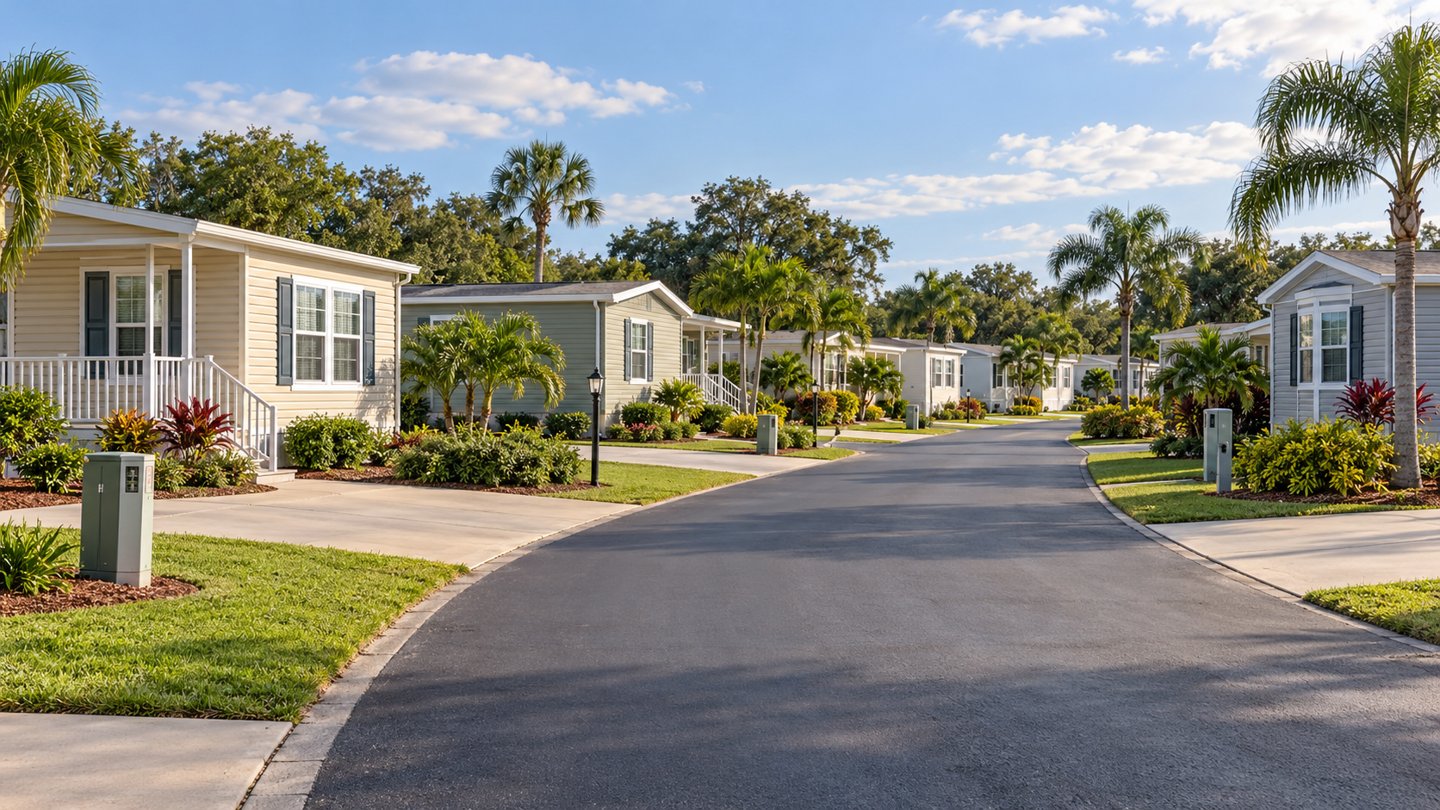
A mobile home park DSCR loan is commercial financing evaluated partly against a manufactured housing community's income and debt payments. The lender distinguishes rent for the land from rent for park-owned homes, then reviews infrastructure, occupancy, collateral and sponsor experience. A strong gross-rent total doesn't guarantee that every dollar will support the real estate loan.
This guide includes a TOH-versus-POH income model and a hypothetical 45-pad Central Florida example. Its rate, LTV and income-recognition assumptions are editable scenarios. No percentage haircut, insurance premium or loan approval is presented as a universal industry rule.
Why Lenders Consider Manufactured Housing Communities
A community can produce recurring income from many rented sites while offering residents a place for homes they own. That business model differs from renting a house or financing an individual manufactured home. The real estate, common infrastructure, resident agreements and any park-owned homes need to be understood separately.
Long resident tenure can support stable collections, but it doesn't make a property recession-proof. Employment, affordability, insurance costs, storm damage, resident turnover and infrastructure failures can change operations. Don't turn the idea of durable housing demand into an assumption of permanent full occupancy or unrestricted rent growth.
The lender needs a viable community and a capable operator. Verify the rent roll, collection history, legal pad count, licenses or permits, infrastructure condition and ownership records. Record vacant approved sites separately from raw land or spaces that cannot currently accept a home. A marketing description of “45 pads” may hide important differences in usable inventory.
Conventional and specialist lending are different channels
An individual-home mortgage program doesn't establish community eligibility. Fannie Mae has a separate manufactured housing community program, and banks and specialist commercial lenders may offer other structures. The DSCR loan guide explains the ratio, but a residential rental program isn't automatically suitable for park collateral.
“No tax returns” also isn't a community-financing guarantee. A lender may request borrower financial information, liquidity, operating statements, experience and guarantees. Ask for the actual document checklist and underwriting process. Confirm whether the proposal finances stabilized real estate, park-owned home inventory, improvements or some combination.
The Core Distinction: Tenant-Owned Homes vs Park-Owned Homes
Tenant-owned homes, or TOH, generally generate site rent for the park. Park-owned homes, or POH, can generate both a site-rent component and compensation for use of the home. Separate those components before calculating coverage. The owner also bears different maintenance, turnover and title responsibilities for homes it owns.
Suppose a resident-owned home pays $500 monthly for its site. A park-owned home collects $800 total, allocated in a hypothetical model as $500 site rent and $300 home rent. The POH's extra $300 isn't automatically equivalent in risk or lender treatment to the site's $500.
The home itself may require roofs, plumbing, appliances, HVAC and interior repairs, depending on the lease and applicable law. During turnover, the home can need work before the site produces its next full collection. Include those recurring costs and separately budget major replacements. Calling POH income “upside” without funding the associated obligations overstates the benefit.
Match the legal inventory to the income
For each home, identify its owner, title status, lien information and the agreements supporting collections. A seller's spreadsheet is not evidence of clear ownership. Some assets may be personal property, some may have different legal treatment, and a lender may require a separate collateral or legal review.
Keep resident-owned home purchase obligations separate from the park's ordinary site rent where applicable. Don't count home sale proceeds or principal collections on a financed home sale as recurring pad rent. A property budget and a lending model need a consistent distinction between recurring operating income, financing receipts and asset sales.
Why Underwriters May Discount or Exclude POH Home Rent
The portion of rent attributable to a park-owned home may receive a different treatment because the loan's collateral, operating expenses and risk differ from pure site income. A lender might recognize some home income, apply an adjustment or exclude it from the real estate sizing. Ask for its method in writing; don't assume a universal 50% discount.
Income recognition and physical eligibility are separate questions. A community could have acceptable cash flow but exceed a program's POH concentration limit. Conversely, it can satisfy an inventory mix requirement but produce too little qualifying income after taxes, insurance, utilities and maintenance.
The Fannie Mae MHC term sheet states that POH generally should not exceed 25%, with up to 35% allowed alongside a plan to reduce the share. It also lists stabilized professional management and a minimum of 50 pad sites. Those are specific program criteria, not national legal limits or approval promises.
Ask how the lender defines the concentration denominator: homes, occupied sites, all approved pads or another measure. Report the underlying counts, not just a percentage. Ten park-owned homes out of forty existing homes equal 25%, while ten out of forty-five approved pads equal 22.22%. The difference is arithmetic, but the lender decides which measure applies.
Keep expenses when testing an income haircut
If the lender excludes part of home income, the owner can still have the full repair obligation. Our model retains all entered home operating costs under every income-recognition scenario. That is a conservative ownership stress, not a claim that every lender applies this exact expense treatment.
Ask the lender to reconcile its NOI adjustments with the owner's actual budget. A loan may be sized without home income while the owner still depends on it to fund maintenance. The rental-property DSCR calculation guide explains the income-to-NOI bridge; the important addition here is keeping site and home economics separate.
TOH vs POH Pad Rent Underwriting Modeler
Enter approved sites, the two home inventories, occupancy assumptions and rent components. Site rent is charged once on occupied TOH and POH sites. The additional POH home-rent premium is entered separately, so the model doesn't double-count the land component of a combined lease payment.
Mobile Home Park TOH vs POH Pad Rent Underwriting Modeler
Pad rent is counted once on occupied TOH and POH sites. Income recognition is a user assumption, and full entered POH costs remain in every scenario.
The tool reports full-income, entered-recognition and pad-only coverage. Pad-only cash flow excludes the home-rent premium but retains the entered home costs and reserves. Empty approved sites produce no rent. Other income is a separate annual input and must be independently supported.
Use the local save function to keep one scenario in this browser, or export a CSV snapshot. Neither creates a cloud account or lender submission. Avoid resident names, account information and private documents. The model screens arithmetic only; it doesn't determine whether a home title, lease or utility system is legally acceptable.
Utility Infrastructure: Public Service vs Private Systems
Water and wastewater infrastructure can dominate a park's risk and capital budget. A connection to public utilities doesn't remove all responsibility: internal pipes, meters, leaks and collection practices may still belong to the owner. Verify where ownership and maintenance responsibility change along the network.
For a private well or septic system, obtain the applicable permits, operating records, inspections, service agreements, capacity evidence and compliance history. Use appropriately qualified professionals to evaluate the actual system. A current operating record doesn't prove sufficient capacity for added sites or new occupancy.
The EPA's mobile home park indicator reference explains why drinking-water and onsite wastewater conditions deserve attention in these communities. It isn't an inspection report for your acquisition. Local regulators and the relevant state agencies determine the requirements for the specific system.
Reimbursements and capital obligations
A utility reimbursement is revenue only to the extent it is legally chargeable and realistically collectible. Show the full underlying expense alongside it. If a provider bills the park $30,000 and residents reimburse $24,000, the net ownership cost is $6,000 before other administration or losses. Don't add $24,000 income while deducting only the net $6,000 expense.
Rent and utility billing practices can be governed by state and local requirements and resident agreements. Have counsel confirm notice, billing, pass-through and rent-change obligations for the transaction. The calculator won't infer those rules from a state name or assume a proposed increase can start immediately.
Set aside capital funding separately from recurring utilities. Replacing a sewer line or correcting drainage can require cash before any higher site rent is collected. A private system's potential capital requirement can outweigh an apparently attractive DSCR. Include the engineer's recommended work and timing in the purchase budget, then ask the lender about holdbacks or reserves.
LTV and Interest Rates: Testing 65%–75% Scenarios
Use 65%, 70% and 75% LTV as scenarios until a lender provides a property-specific limit. There isn't one mandatory range for all manufactured housing communities. Value, sponsor, income, infrastructure, property size and the financing program can change available proceeds.
The Fannie Mae term sheet lists maximum 80% LTV and minimum 1.25x DSCR, subject to its requirements. That illustrates why a blanket claim that all community loans stop at 75% is inaccurate. It doesn't mean an 80% advance is available to a small park or a property with significant infrastructure work.
At a $2 million value, a 65% loan is $1.3 million, 70% is $1.4 million and 75% is $1.5 million. Purchase equity at the same price is $700,000, $600,000 or $500,000 before transaction costs and reserves. A value cap can allow a balance that income cannot support.
At an illustrative 7.50% rate with 30-year amortization, $1.4 million requires approximately $117,468.04 annual P&I. Compare that with accepted lender cash flow, not total gross rent. The commercial debt-yield and DSCR guide explains why income and collateral constraints need separate calculations.
Rates and maturity need their own comparison
The calculator's 7.50% is a hypothetical fixed rate. Our daily checked market benchmark page supplies dated context, not a community loan quote. Request the actual margin, rate period, fees, amortization, maturity, recourse and prepayment terms for the proposed facility.
A ten-year maturity with thirty-year amortization leaves a balloon balance. Underwrite the exit using documented loan terms and a reasonable downside scenario. A future refinance requires another credit decision; neither the current DSCR nor the value of the land guarantees a replacement loan.
Case Study: A Hypothetical 45-Pad Central Florida Community
Assume forty-five legally approved pads: thirty with tenant-owned homes, ten with park-owned homes and five empty sites. For this constructed example, all forty existing homes are occupied. Site rent is $500 monthly for each occupied site, and POH residents pay an additional $300 monthly home-rent component.
Apply a 5% collection-loss allowance to both rent components. Site rent becomes $228,000 annually after that allowance. POH home-rent collections become $34,200. Annual common operating expenses are $80,000, additional POH operating costs are $15,000, and replacement reserves are $10,000. These are scenario assumptions, not Florida operating benchmarks.
| Underwriting line | Hypothetical result |
|---|---|
| Annual collected site rent | $228,000.00 |
| Annual collected POH home premium | $34,200.00 |
| Full-income NOI | $167,200.00 |
| Full-income cash flow after reserves | $157,200.00 |
| 50%-recognized cash flow after reserves | $140,100.00 |
| Pad-only cash flow, all costs retained | $123,000.00 |
| Annual P&I | $117,468.04 |
| Full-income DSCR | 1.3382x |
| 50%-recognized DSCR | 1.1927x |
| Pad-only DSCR | 1.0471x |
At full home-income recognition, NOI is $167,200 and reserve-adjusted cash flow is $157,200. At 50% recognition, qualifying cash flow falls to $140,100. With the home-rent premium excluded entirely, the conservative pad-only cash flow is $123,000 because the model retains the owner's entered home costs.
Assume $2 million value and a $1.4 million loan at 7.50%, amortized over thirty years. Full-income coverage is about 1.3382x, but 50%-recognized coverage is only about 1.1927x. The property can appear to clear an entered 1.25x target until the income treatment is changed. The pad-only result is weaker still.
The 45-pad example doesn't meet every program's size rule
The example is below the 50-pad minimum on the cited Fannie Mae term sheet. Stronger coverage or more equity wouldn't satisfy that particular minimum. Ask a bank or specialist commercial lender about an eligible alternative rather than describing this as an agency-approved deal.
Axos Bank's published commercial property categories include mobile home parks, making it one possible inquiry channel. Its page isn't a commitment on this example. Verify minimum size, infrastructure acceptance, POH treatment and required sponsor experience directly.
For a Central Florida acquisition, add property-specific hazard, wind and flood review. A general state insurance figure won't establish the cost or availability of coverage for the community. Our Florida insurance underwriting guide can help organize the questions, while actual policy terms must come from qualified insurance professionals.
Closing Diligence and Ownership Planning
Match the title, home inventory and rent roll before finalizing the loan request. Review legal site counts, resident agreements, utility obligations, insurance, environmental conditions and required repairs. Keep a buyer-specific tax estimate rather than assuming the seller's annual assessment remains unchanged.
Ask how the lender treats home dispositions, replacements, pad infill and any proposed conversion from POH to TOH. A business plan to reduce park-owned inventory needs funding, legal review and resident-sensitive execution; it isn't just a lower percentage typed into next year's worksheet.
Before removing contingencies, compare accepted loan proceeds with purchase equity, closing costs, operating cash and near-term capital work. Recalculate if a utility inspection or insurance quote changes the budget. A transparent loan request can explain which figure changed and why, instead of relying on a gross-rent headline.
Separate home-sale proceeds from recurring rent: When a park sells a park-owned home but continues renting the pad, the sale receipt and future pad income belong in different lines. Remove any home-rent component that ends after the sale and update the expense allocation. A temporary cash receipt shouldn’t be annualized into NOI supporting permanent debt.
Frequently Asked Questions
How is pad rent different from park-owned home rent?
Pad rent compensates the park for the site. A park-owned home may also generate an additional home-rental component with different costs, collateral treatment and lender acceptance. Separate the components rather than counting a combined payment twice.
Do lenders always exclude POH home income?
No universal rule is used here. A program may recognize, adjust or exclude the home-rental component, and it may apply separate concentration and collateral requirements. Ask the lender for its documented treatment and expense assumptions for the actual community.
Can a 45-pad park qualify for the cited Fannie Mae program?
The published term sheet cited in this guide lists a minimum of 50 pad sites, so the hypothetical 45-pad example does not meet that stated minimum. An eligible alternative may exist through another commercial lender, subject to its own review.
Are private wells or septic systems automatically ineligible?
No blanket eligibility conclusion is made here. The lender and relevant authorities need property-specific evidence on permits, condition, capacity and compliance. Qualified professional review and capital budgeting are essential; the calculator does not inspect infrastructure.
Are all mobile home park loans limited to 65%–75% LTV?
No. Those figures are comparison scenarios. The cited agency term sheet has different published limits, while individual properties can receive lower proceeds because of income, value or other requirements. Obtain current transaction-specific terms.
Why does the pad-only scenario keep POH expenses?
The owner may still owe maintenance and operating costs even when a lender excludes home income. The tool retains all entered home costs to show a conservative ownership stress. A lender may use a different documented adjustment, which should be reconciled separately.
Prepared by Maniteja, investor. Examples are hypothetical. Sources were checked October 30, 2026. The model doesn't approve financing, evaluate home titles or determine resident, utility or insurance obligations under applicable law.
Leave a Reply