

Sources checked October 14, 2026. Linked lender and agency guidance can change. Confirm current eligibility and terms directly before making a financing decision.
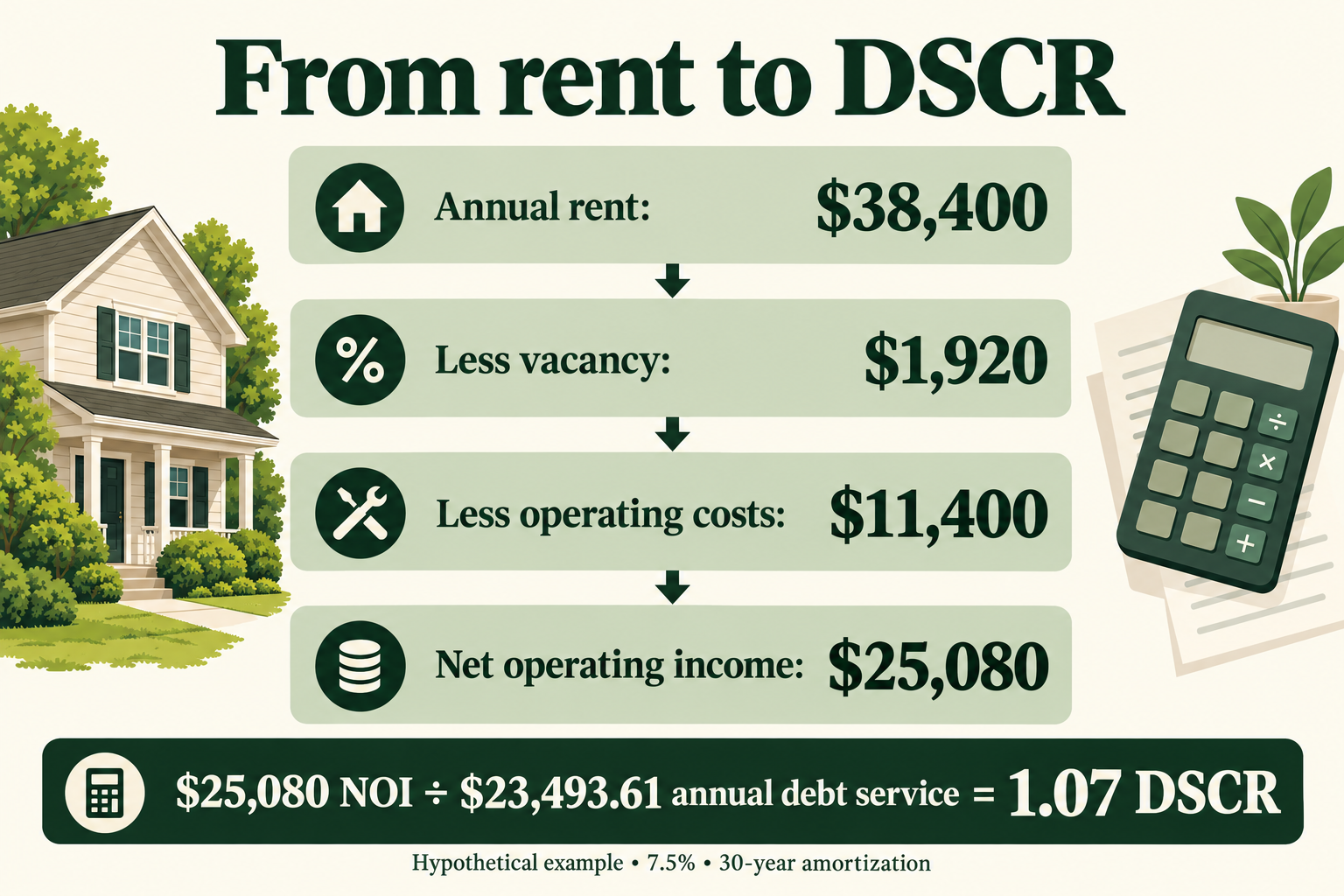
To calculate DSCR, subtract vacancy and operating expenses from annual rental income, then divide the resulting net operating income by annual debt service. For example, $25,080 of NOI divided by $23,493.61 of principal and interest gives a DSCR of 1.07. Confirm the lender’s formula before comparing that result with its requirements.
That last check matters. Some residential rental lenders calculate coverage using monthly rent divided by PITIA: principal, interest, taxes, insurance and applicable association dues. The same property can show 1.07 using NOI and 1.28 using rent-to-PITIA. You need to know which calculation you’re reading.
This walkthrough keeps one hypothetical $350,000 rental property on the worksheet from start to finish. Every rate and expense below is an illustration, not a current lender quote or a verified property listing. For the wider financing context, read the DSCR loan guide.
How to calculate DSCR in four steps
- Annualize the property’s gross rental income.
- Deduct vacancy and operating expenses to calculate NOI.
- Calculate annual debt service using the proposed payment schedule.
- Divide NOI by annual debt service, keeping both figures in the same period.
Collect the lease or supported rent estimate, tax information, insurance quote, operating budget and loan terms before starting. The arithmetic takes minutes. Reliable inputs take more work.
The DSCR formula: NOI divided by annual debt service
DSCR = annual net operating income ÷ annual debt service.
NOI measures property income remaining after operating costs, before financing costs. Debt service measures the scheduled loan payments included in the analysis. For the amortizing mortgage example here, that means principal and interest.
The income calculation has an intermediate step:
Potential gross rent − vacancy and collection losses = effective gross income, or EGI.
EGI − operating expenses = NOI.
Other eligible property income can enter EGI, but we assume none in this example. Don’t add a security deposit as revenue simply because it reached your bank account. Likewise, cash received from refinancing isn’t operating income.
Suppose NOI is $30,000 and annual debt service is $24,000. Coverage is 1.25: $1.25 of NOI for each dollar of scheduled debt payment. The remaining $6,000 may still need to fund major replacements or costs excluded from the NOI definition.
A 1.25 ratio is a mathematical relationship, not a statutory approval threshold. Lenders define their own requirements. The calculator methodology explains this site’s NOI-based approach.
Step 1: Determine annual rental income and vacancy
Start with the rent for the property being analyzed. Our example has one unit renting for $3,200 per month:
$3,200 × 12 = $38,400 in potential annual rent.
For multiple units, total the rent across the included units before annualizing it. Keep the income and financing tied to the same property. A rent roll from one building can’t support a ratio against another building’s loan.
Next, deduct a vacancy and collection allowance. Using a hypothetical 5% allowance:
$38,400 × 5% = $1,920.
$38,400 − $1,920 = $36,480 EGI.
Five percent is an example assumption. A signed lease doesn’t eliminate vacancy risk, and an empty unit may need a different first-year budget from a stabilized rental. Distinguish a projection from recorded collections. Label which one you’re using.
For short-term rentals, estimate the full year’s revenue using defensible occupancy and nightly-rate assumptions. Include seasonality. If cleaning fees enter income, put the corresponding cleaning cost in expenses. A busy holiday month multiplied by twelve can overstate annual revenue.
What goes wrong here: entering $3,200 in an annual-income field. That models one month’s rent as a full year. The opposite mismatch, using annual income against monthly debt service, can make coverage look twelve times larger than it should.
Step 2: Itemize operating expenses and calculate NOI
Subtract the costs of running the property from EGI. Keep mortgage principal and interest out of this step; they’ll enter the denominator later.
| Operating-cost assumption | Monthly equivalent | Annual amount |
|---|---|---|
| Property taxes | $400 | $4,800 |
| Property insurance | $150 | $1,800 |
| Routine maintenance allowance | $200 | $2,400 |
| Management allowance | $200 | $2,400 |
| Total operating costs | $950 | $11,400 |
These figures are deliberately transparent rather than presented as local averages. Replace them with property-specific evidence. Include owner-paid utilities, association dues and other recurring operating costs when applicable. This example assumes no additional items.
The NOI calculation is now:
$36,480 EGI − $11,400 operating expenses = $25,080 annual NOI.
Management fees deserve a careful read. A contract may charge a percentage of rent collected, a leasing fee, or separate charges for renewals. Our $2,400 allowance isn’t a representation of that contract. Use the actual fee structure when comparing a real property.
Taxes and insurance can change after purchase or renewal. An old bill is useful evidence, but it may not describe your future cost. A modest change matters when the modeled cash surplus is thin.
Which expenses belong outside NOI?
Mortgage principal and interest are financing costs in this NOI-based model. Income taxes, depreciation and the purchase down payment also don’t enter this simplified operating calculation. A roof replacement or major renovation needs a separate capital budget; it isn’t interchangeable with routine maintenance.
Lender treatment of replacement reserves and adjustments can differ. Ask for the underwriting definition instead of assuming your worksheet is identical to theirs. Keep excluded cash needs visible even if they don’t reduce underwriting NOI.
What goes wrong here: subtracting vacancy twice. If you already reduced gross rent to EGI, don’t deduct the same allowance again as an operating expense. When using this site’s total-expenses field with unreduced gross rent, include vacancy in that total once.
Step 3: Calculate monthly payments and annual debt service
Our hypothetical purchase price is $350,000. A 20% down payment is $70,000, leaving a $280,000 loan. Assume 7.5% annual interest, monthly payments and a 30-year amortization period.
For a fixed-rate amortizing loan, the payment equation is:
Monthly payment = P × r ÷ [1 − (1 + r) raised to the power −n].
Here, P is the $280,000 principal, r is the monthly rate of 0.075 ÷ 12 = 0.00625, and n is 30 × 12 = 360 payments. Apply those inputs:
Monthly principal and interest ≈ $1,957.80.
Annual debt service ≈ $23,493.61.
The annual amount uses the unrounded monthly payment. Multiplying the displayed $1,957.80 by twelve gives $23,493.60, a one-cent rounding difference. Retain full precision until the final display rather than trying to reconcile rounded subtotals exactly.
A zero-interest amortizing loan needs a separate calculation: principal divided by the number of payments. An interest-only loan also needs a different formula. Payment frequency, a remaining amortization schedule or another scheduled debt obligation can change the denominator.
Where PITIA belongs in a residential DSCR calculation
For rent-to-PITIA, add the monthly housing costs to the mortgage payment. This example has $400 of taxes, $150 of insurance and no association dues:
$1,957.80 + $400 + $150 = $2,507.80 PITIA.
$3,200 monthly rent ÷ $2,507.80 PITIA ≈ 1.28.
That formula doesn’t separately subtract our vacancy, maintenance and management allowances. It answers a different coverage question. Avoid dividing NOI, which already deducts taxes and insurance, by PITIA that includes those costs again unless a lender explicitly specifies an adjusted method.
The comparison of NOI and rent-to-PITIA explains the difference. This site’s calculator uses NOI; it doesn’t produce a lender-specific qualification decision.
Step 4: Calculate DSCR for the rental property
With NOI and debt service established, divide:
$25,080 ÷ $23,493.61 = 1.0675, or approximately 1.07 DSCR.
Under these assumptions, operating income covers the annual principal-and-interest obligation with a small surplus. To put that surplus in dollars:
$25,080 − $23,493.61 = $1,586.39 per year.
That’s roughly $132.20 per month before major replacements and other excluded costs. Coverage above 1.00 doesn’t tell you whether you have enough cash to handle an interruption in rent.
| Ratio | Arithmetic meaning | Question to ask |
|---|---|---|
| Below 1.00 | Defined income is below defined payments | How is the shortfall funded? |
| 1.00 | Defined income equals defined payments | Which cash costs remain excluded? |
| 1.25 | Defined income is 25% above defined payments | Does this match the lender’s method and target? |
| 1.35 | Defined income is 35% above defined payments | How reliable are the income assumptions? |
These are explanatory reference points, not universal lending rules. A lender may accept or require a different ratio alongside credit, reserves, property eligibility and loan-to-value checks.
Worked example: a hypothetical $350,000 rental purchase
Here is the full worksheet in one place. It can be used to understand a proposed rental in Dallas or elsewhere, but it isn’t a Dallas market estimate. No address, rent comparable, local tax bill or actual loan offer has been verified.
| Calculation stage | Amount |
|---|---|
| Purchase price | $350,000 |
| Down payment, excluding closing costs | $70,000 |
| Loan principal | $280,000 |
| Potential annual rent | $38,400 |
| Vacancy allowance | −$1,920 |
| Effective gross income | $36,480 |
| Operating expenses | −$11,400 |
| NOI | $25,080 |
| Annual principal and interest | $23,493.61 |
| NOI-based DSCR | 1.07 |
| Annual surplus after modeled debt service | $1,586.39 |
Test the same numbers in the calculator
Debt Service Coverage Ratio = net operating income ÷ annual debt service.
Same property, two DSCR methods
Operating budget
—Annual NOI ÷ annual principal and interest
Lender method estimate
—Qualifying monthly rent ÷ PITIA
PITIA includes principal, interest, taxes, insurance and association dues. Non-monthly debt payments are annualized and divided by 12. The operating result uses your total expenses, including vacancy and management only when entered or included in the estimate. Cash flow is before capital replacements, repair reserves and income tax. Neither ratio confirms loan approval; lender rules vary.
- Net operating income
- —
- per year
- Annual debt service
- —
- per year
- Net cash flow
- —
- per year
- Max loan at target DSCR
- —
Sensitivity
| Loan amount, interest rate | −2% | Your rate | +2% |
|---|---|---|---|
| Loan −10% | — | — | — |
| Your loan | — | — | — |
| Loan +10% | — | — | — |
Note. Results are informational estimates only and do not constitute financial advice or a loan offer. Balloon payments, blended portfolios and lender-specific requirements are not modeled. Confirm qualification with your lender.
Enter $38,400 as annual gross rental income, $13,320 as total annual expenses, $280,000 as the loan, 7.5% as the rate and 30 years as the term. The $13,320 expense total combines vacancy of $1,920 with operating costs of $11,400.
Use monthly amortizing payments. You should see approximately $25,080 NOI, $23,494 annual debt service after display rounding, and 1.07 DSCR. The free DSCR calculator also lets you edit expenses and compare payment options.
Change one assumption at a time. Use Copy summary or Share link to keep the inputs with the result, then save that link for a loan officer or broker. Shared links can expose the entered figures, so use nonconfidential scenarios.
Principal and interest versus interest-only payments
Interest-only payments remove scheduled principal repayment during the specified period. With the same $280,000 balance and 7.5% rate:
$280,000 × 7.5% ÷ 12 = $1,750 monthly interest.
Annual debt service becomes $21,000. NOI-based coverage is $25,080 ÷ $21,000 = 1.1943, or 1.19.
| Same property, same rate | Amortizing payments | Interest-only payments |
|---|---|---|
| Monthly principal and interest, or interest only | $1,957.80 | $1,750.00 |
| Annual modeled debt service | $23,493.61 | $21,000.00 |
| NOI-based DSCR | 1.07 | 1.19 |
| Annual surplus before excluded costs | $1,586.39 | $4,080.00 |
| Scheduled principal reduction | Included | None during interest-only period |
The unrounded coverage increase is approximately 0.127, usually described as 0.13 ratio points. The effect depends on the rate and amortization assumptions.
What happens after a ten-year interest-only period?
Suppose the loan has a 30-year total term, the first ten years are interest only, and the unchanged $280,000 balance then amortizes over twenty years at the same hypothetical 7.5% rate. The new monthly payment would be about $2,255.66. Keeping NOI unchanged, coverage would fall to about 0.93.
That example assumes a particular contract structure. A real loan may have different rate-reset terms, maturity or payoff requirements. Confirm the schedule and whether the lender qualifies using the interest-only payment or an amortizing payment. The calculator models a selected payment type; it doesn’t automatically simulate that future transition.
For the related risks, read the interest-only discussion in the DSCR loan guide.
Use the DSCR formula to test rent and cost changes
You can reverse the calculation to find the income required for a target. With our fixed $11,400 operating-cost budget and 5% vacancy allowance:
Annual gross rent required = (operating costs + target DSCR × annual debt service) ÷ 0.95.
At 1.00 coverage, the required monthly gross rent is approximately $3,060.84. At a 1.25 target, it’s approximately $3,576.05. Those results assume operating costs stay constant as rent changes; percentage-based management charges would alter the calculation.
Don’t treat the higher rent as achievable because the equation needs it. Check supported rent first. The reverse calculation tells you the gap between a scenario and a chosen target, rather than proving the market will close that gap.
Increasing operating costs by $1,200 per year reduces NOI to $23,880 and coverage to about 1.02 at the original payment. That’s why a property with a 1.07 starting ratio deserves a careful operating budget. Compare financing sensitivity through the calculator’s rate scenarios, using the actual rate from a written quote.
Conventional qualifying income and DSCR are different calculations
Conventional investment-property financing can use rental income in qualification. Fannie Mae’s September 2, 2026 subject-property guidance describes a purchase calculation that uses 75% of gross monthly rent and then subtracts PITIA. The treatment of the result depends on eligibility and management experience; refinance calculations can follow a different documentation path.
That qualifying method isn’t the same as our property NOI worksheet. Don’t impose its 25% adjustment and also deduct your full operating budget unless the specific calculation requires both.
Some DSCR programs assess property rental coverage without W-2s or personal tax returns for income qualification. They can still require credit, asset and property documents. Compare each program’s written terms rather than assuming every product described as non-QM works identically.
The DSCR versus conventional financing comparison covers the broader decision.
Common DSCR calculation mistakes to correct before applying
| Mistake | Correction |
|---|---|
| Monthly income divided by annual debt | Put both figures in the same period. |
| Mortgage payments deducted inside NOI | Remove those payments from operating costs and model debt service separately. |
| Taxes and insurance deducted in NOI and counted again in PITIA | Confirm the formula and count each cost according to that definition. |
| Purchase price entered as the loan amount | Use the proposed principal after the down payment. |
| Unsupported asking rent used as accepted lender rent | Confirm the lease, appraisal and program’s qualifying-rent rules. |
| Interest-only coverage assumed to last after payments recast | Calculate the later scheduled payment separately. |
These mistakes can distort a worksheet. A denial also may involve credit, reserves, condition or property eligibility. A corrected ratio alone doesn’t guarantee approval. The loan-requirements section helps you prepare questions for underwriting.
Questions about how to calculate DSCR
Can I calculate DSCR using monthly figures?
Yes. Monthly NOI divided by matching monthly debt service produces the same ratio as annual figures when the assumptions are consistent. Annual totals are often easier for seasonal income and irregular expenses. Don’t mix the periods.
Is DSCR the same as cash flow or return on investment?
No. DSCR is a coverage ratio. Cash flow is a dollar amount after the costs included in your model. Return on investment needs a separate definition and an investment amount. A 1.25 DSCR doesn’t imply a 25% return.
Does NOI include the mortgage payment?
In the NOI-based calculation used here, mortgage principal and interest are excluded from operating expenses. They enter debt service. Confirm the lender’s definition for adjustments and other obligations.
Can a property have negative DSCR?
Negative NOI divided by positive debt service produces a negative ratio. That signals an operating deficit under the modeled assumptions. With zero debt service, division is undefined; don’t describe a debt-free property’s ratio as zero.
Keep the worksheet with the result
Save the rent evidence, vacancy assumption, expense budget and payment schedule alongside the ratio. Name the method explicitly: NOI-based or rent-to-PITIA. That makes a discussion with a lender much more useful than sending a number without its inputs.
Use the DSCR calculator to test the worksheet, then compare the lender’s written calculation. Read the calculation limitations before relying on any modeled result. If a figure looks inconsistent, report the calculation issue with nonconfidential example inputs.
Leave a Reply