

Sources checked October 14, 2026. Linked lender and agency guidance can change. Confirm current eligibility and terms directly before making a financing decision.
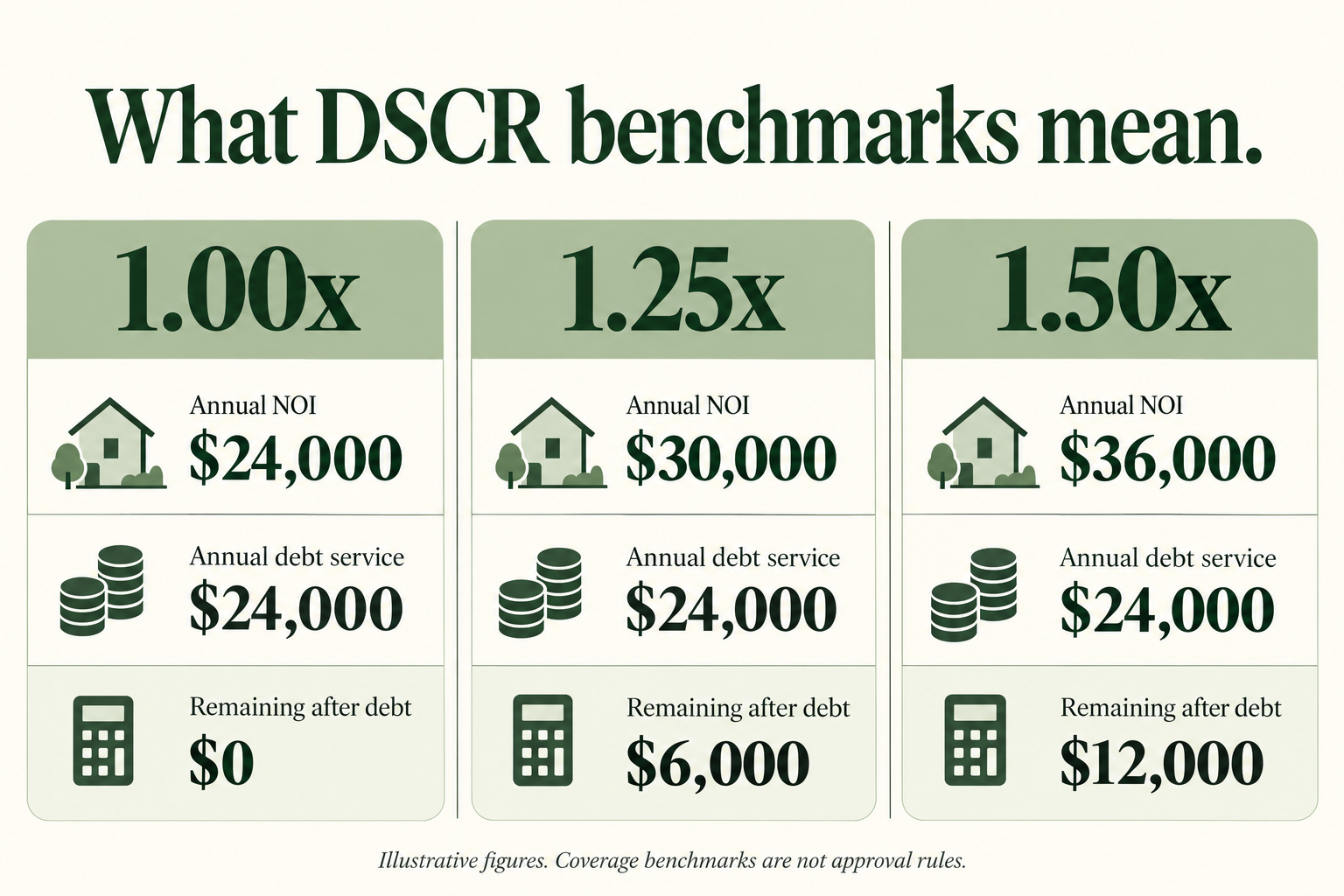
A good DSCR ratio for an initial rental-property screen is often 1.25 or higher, calculated with realistic income and expenses. At 1.25, the income used in the calculation is 25% greater than the debt payments. A ratio of 1.00 covers those payments exactly; 1.50 provides a larger cushion. These are planning benchmarks, not universal lender approval rules.
Before comparing properties, check which formula you are using. A commercial calculation based on net operating income can produce a different answer from a residential lender’s rent-to-payment calculation. The same house can look comfortable under one method and tight under the other.
This guide compares the numbers, explains what a minimum DSCR actually tells you, and shows how to improve coverage without relying on optimistic rent projections. For the basics of the loan itself, read our DSCR loan guide.
In this guide
- What the ratio measures
- Compare 1.0, 1.25 and 1.50
- Coverage benchmark table
- Commercial and residential calculations
- Five ways to improve coverage
- Test your property
- Frequently asked questions
What the ratio measures
Debt service coverage ratio compares property income with the payments needed to service its debt. For a calculation based on net operating income, the formula is DSCR = annual NOI / annual debt service. Both figures must cover the same period.
NOI is rental income after vacancy and operating expenses, before mortgage payments. Debt service usually includes the scheduled principal and interest payments. You should not subtract the mortgage payment when calculating NOI and then divide by that same payment again.
Suppose a property produces $30,000 of annual NOI and requires $24,000 in annual debt payments. Its DSCR is $30,000 / $24,000 = 1.25. After paying the debt, $6,000 remains in this simplified example. That amount is not necessarily distributable profit: major replacements, capital expenditure, loan fees and income taxes can still affect your results.
The ratio measures coverage, not the quality of the investment as a whole. It does not tell you whether you paid a sensible purchase price, whether the roof needs replacement, or whether the neighborhood’s rental demand is weakening. A good DSCR ratio belongs beside those questions, rather than replacing them.
Compare 1.0, 1.25 and 1.50
Below 1.00: income does not cover debt
At 0.90 DSCR, a property with $24,000 of annual debt service has only $21,600 of income available under the selected formula. The $2,400 gap needs another funding source. With an NOI-based calculation, the shortfall exists even after the modeled operating expenses have been paid.
A low ratio may reflect temporary vacancy, a lease below market rent, high financing costs, or an overestimated purchase budget. Those causes call for different responses. Do not assume a future rent increase fixes a current funding gap unless you can support the increase and afford the period before it happens.
Whether financing is available below 1.00 depends on the lender and program. Availability would not change the property math. Keep the underwriting decision separate from your ability to carry the investment through a weak year.
1.00 to 1.19: positive coverage with a thin margin
A 1.00 DSCR is break-even for the income and debt figures you entered. At 1.10, $26,400 of annual income supports $24,000 of annual debt service, leaving $2,400 after those payments. That surplus can disappear quickly if the original budget left out vacancy, management or routine maintenance.
The range can deserve a closer look when there is documented room to improve performance. It can also signal that the asking price or loan amount leaves too little flexibility. Review the expenses line by line before treating a ratio slightly above 1.00 as comfortable.
1.20 to 1.25: a useful screening range
At 1.20, the example property needs $28,800 of annual NOI. At 1.25, it needs $30,000. The extra $1,200 between these two ratios is a measurable improvement, but it does not automatically move a loan into a better interest-rate tier.
For an investor setting a first-pass target, 1.25 can be a useful starting point because it leaves a visible margin above scheduled debt payments. It should still be tested against vacancy, rising insurance costs and the property’s condition. A lender may accept less, require more, or use a different calculation altogether.
1.35 and above: more room, with assumptions to check
A 1.35 ratio supports $24,000 of debt service with $32,400 of annual NOI. That creates an $8,400 modeled surplus after debt. At 1.50, NOI reaches $36,000 and the surplus becomes $12,000.
Higher coverage gives you more room under the same assumptions. It does not guarantee a particular rate, loan-to-value limit or approval. A 1.50 projection based on peak-season short-term rental revenue may be less dependable than 1.25 calculated from a signed annual lease and a complete expense budget.
Check how much cash you invested to achieve the ratio, too. A larger down payment can improve coverage while reducing the cash you have available for repairs or the next purchase. DSCR and return on invested cash answer different questions.
Coverage benchmark table
The table assumes $24,000 of annual debt service. Required NOI equals the ratio multiplied by that amount. The figures illustrate coverage only; they are not a lender’s pricing matrix.
| DSCR | Required annual NOI | Remaining after debt |
|---|---|---|
| 0.90 | $21,600 | -$2,400 |
| 1.00 | $24,000 | $0 |
| 1.05 | $25,200 | $1,200 |
| 1.10 | $26,400 | $2,400 |
| 1.15 | $27,600 | $3,600 |
| 1.20 | $28,800 | $4,800 |
| 1.25 | $30,000 | $6,000 |
| 1.30 | $31,200 | $7,200 |
| 1.35 | $32,400 | $8,400 |
| 1.40 | $33,600 | $9,600 |
| 1.45 | $34,800 | $10,800 |
| 1.50 | $36,000 | $12,000 |
Every 0.05 increase here requires another $1,200 of annual NOI if debt service stays fixed. There is no universal rule that each 0.05 increase earns an interest-rate discount. Request the actual lender’s current terms for your credit profile, property and loan purpose.
How much can income fall before break-even?
The decline that brings coverage down to 1.00 is 1 – (1 / DSCR), assuming debt service remains unchanged. At 1.25, that is 20%. At 1.50, it is about 33.3%.
This is a decline in the income figure used in the ratio, not necessarily a decline in gross rent. Operating expenses do not always fall when rent falls. A 10% loss of gross rent can cause a larger percentage loss of NOI because taxes, insurance and many other bills continue.
For example, $38,400 of annual rent, a 5% vacancy allowance and $11,400 of operating expenses produce $25,080 of NOI. If gross rent falls 10%, the same vacancy percentage and expenses leave $21,432 of NOI. That is a roughly 14.5% NOI decline, despite only a 10% decline in gross rent.
Commercial and residential calculations
For commercial property analysis, DSCR commonly compares NOI with debt service. Many residential DSCR lenders instead compare monthly qualifying rent with PITIA: principal, interest, property taxes, insurance and association dues. Ask which method applies before deciding whether your ratio meets a requirement.
Consider a $350,000 rental with 20% down, a $280,000 loan, a 7.5% interest rate and a 30-year amortization schedule. Monthly principal and interest are approximately $1,957.80. Annual debt service is about $23,493.61.
Using the $25,080 NOI above gives 1.07 DSCR. But with $3,200 monthly rent, $400 monthly taxes, $150 monthly insurance and no association dues, rent divided by PITIA is approximately 1.28. Both calculations use the same property; they measure income and expenses differently.
Do not compare these results as if they were interchangeable. The rent-to-PITIA calculation does not deduct your full vacancy, maintenance and management budget in the same way as NOI. Keep a separate operating cash-flow analysis even if your lender uses the rent-based method.
Our step-by-step rental-property calculation guide explains the inputs and expense treatment in more detail.
What is the minimum DSCR for a rental property?
The minimum is a program requirement, not a single legal standard shared by every lender. Credit, property type, loan purpose, leverage and the income calculation can change the answer. A threshold mentioned in a marketing summary should be checked against the terms of your actual quote.
As one concrete example, LendingOne’s published broker guidelines reviewed for this article list a minimum DSCR of 1.20 for credit scores below 720 and 1.10 for scores of 720 or higher, using rent divided by PITIA. This illustrates why a blanket statement that every rental loan requires 1.25 would be misleading. Confirm current program availability with the lender.
Ask for the qualifying rent figure, the payment components, the minimum coverage requirement and any additional conditions in writing. A ratio alone cannot tell you the required down payment or cash reserves. A loan that meets the coverage test may still fail another underwriting condition.
Does a higher DSCR get a lower rate?
It can influence a lender’s assessment, but there is no reliable public formula that converts your ratio into a guaranteed discount. Credit, leverage, property characteristics, market conditions and loan structure also affect the quote.
Compare quotes using the same loan amount, term, amortization, points and prepayment terms. A lower advertised rate with substantial upfront points can cost more than it first appears. Ask whether the lender’s actual pricing changes at a specific coverage threshold rather than assuming that 1.35 automatically receives preferred pricing.
If paying down the loan improves your quote, compare the financing benefit with the cash you would give up. Keep enough liquidity for planned work and plausible vacancies. Coverage looks strongest when both the operating budget and the reserve balance can withstand a difficult year.
Five ways to improve coverage
1. Verify income before increasing it
Use signed leases, documented collections or a supportable market-rent estimate. Investigate why the current rent differs from comparable properties. For a short-term rental, account for seasonality, occupancy, platform charges, cleaning arrangements and local restrictions. Peak-month revenue is a weak basis for a full-year loan decision.
2. Reduce avoidable operating costs
Review insurance quotations, utility responsibility, service contracts and recurring repairs. Saving $1,200 annually improves DSCR by about 0.05 when annual debt service is $24,000. Do not improve the spreadsheet by deleting necessary maintenance or assuming you will never need professional management.
3. Test a larger down payment
In the $350,000 example, increasing the down payment from 20% to 25% reduces the loan from $280,000 to $262,500. At the same 7.5% rate and 30-year term, principal and interest fall to about $1,835.44 monthly. With $25,080 annual NOI, coverage improves from roughly 1.07 to 1.14.
That additional $17,500 of cash improves the ratio, but does not reach 1.25 in this example. Test the actual effect before assuming five percentage points more down will solve the problem. Allow separately for closing costs and reserves.
4. Compare financing structures carefully
An interest-only payment can raise initial coverage by reducing scheduled debt service. On the $280,000 loan at 7.5%, annual interest is $21,000 and the example’s NOI-based DSCR becomes about 1.19. The principal balance is not being paid down during that period.
Check the payment after the interest-only period, any rate adjustment and any balloon payment. A structure that improves today’s ratio can create a future payment problem. Run the later payment through the same conservative operating budget.
5. Revisit the purchase price or project
If documented income and sensible financing still leave weak coverage, negotiate the price or reconsider the investment. A spreadsheet cannot turn an unsupported rent forecast into dependable income. Sometimes the strongest decision is to preserve cash for a property whose economics fit your budget.
Test your coverage in the DSCR calculator
Debt Service Coverage Ratio = net operating income ÷ annual debt service.
Same property, two DSCR methods
Operating budget
—Annual NOI ÷ annual principal and interest
Lender method estimate
—Qualifying monthly rent ÷ PITIA
PITIA includes principal, interest, taxes, insurance and association dues. Non-monthly debt payments are annualized and divided by 12. The operating result uses your total expenses, including vacancy and management only when entered or included in the estimate. Cash flow is before capital replacements, repair reserves and income tax. Neither ratio confirms loan approval; lender rules vary.
- Net operating income
- —
- per year
- Annual debt service
- —
- per year
- Net cash flow
- —
- per year
- Max loan at target DSCR
- —
Sensitivity
| Loan amount, interest rate | −2% | Your rate | +2% |
|---|---|---|---|
| Loan −10% | — | — | — |
| Your loan | — | — | — |
| Loan +10% | — | — | — |
Note. Results are informational estimates only and do not constitute financial advice or a loan offer. Balloon payments, blended portfolios and lender-specific requirements are not modeled. Confirm qualification with your lender.
Use the calculator above for an NOI-based scenario. Enter $38,400 annual gross rent, $13,320 annual operating deductions including the modeled vacancy allowance, a $280,000 loan, 7.5% interest and 30 years. The result should be approximately 1.07 DSCR. Include vacancy only once.
Then lower the rent, raise the expenses or change the loan amount. Watch the coverage result move and compare it with your own planning target. The calculator’s result is an estimate; its color indicator does not represent a lender’s approval decision or personalized rate quote.
Frequently asked questions
Is 1.25 a good DSCR ratio?
It can be a useful screening target when the income and expenses are realistic. It means the income used in the formula is 25% above scheduled debt service. Check reserves, major repairs and the lender’s own calculation before relying on it.
Is a 1.00 DSCR enough?
It covers the modeled debt payments exactly, with no cushion in that calculation. Financing eligibility varies by program. For investment planning, test how you would fund a vacancy or unexpected expense rather than treating break-even as a comfortable operating result.
Is 1.50 always better than 1.25?
It provides more coverage under comparable assumptions. But a higher ratio can reflect a larger down payment, incomplete expenses or overstated income. Compare the underlying budget and invested cash, not just the headline number.
What is the ideal debt service coverage ratio for an Airbnb?
There is no universal ideal. Choose a target using a conservative annual revenue forecast and the full operating budget, then stress-test lower occupancy and higher costs. Confirm how the specific lender qualifies short-term rental income.
Can a refinance change my DSCR?
Yes. A different rate, loan balance or repayment schedule changes debt service. A cash-out refinance can increase the balance and reduce coverage even when rent stays unchanged. Compare the new payment and costs with the existing loan before deciding.
Does DSCR include my personal salary?
The property coverage ratio uses the selected property-income calculation. Personal salary is not added to NOI to improve that ratio. Other financing programs and underwriting checks may consider personal income separately.
Before requesting a quote: prepare a current rent figure, a complete expense budget, the proposed payment and your available reserves. Calculate the base case and a weaker-income case. That gives you a more useful conversation than asking for a universal approval threshold.
Leave a Reply