

Sources checked October 14, 2026. Linked lender and agency guidance can change. Confirm current eligibility and terms directly before making a financing decision.
DSCR loan requirements usually include acceptable borrower credit, a down payment or sufficient equity, documented rental income, eligible investment property and verified reserves. The lender then applies its own coverage calculation and program limits. There isn’t one national credit score, down payment percentage or DSCR threshold that qualifies every rental investor.
A property can pass the income test and still fail the appraisal or cash requirements. That’s why the most useful first step is to check the whole file, rather than focus on a single ratio.
This guide covers residential investment financing, with separate notes where commercial properties require a different review. Published lender examples were checked on October 12, 2026. They illustrate how programs differ; they aren’t offers or a promise that the same terms will be available for your application. Our DSCR loan overview explains the financing model before you get into the documents.
Quick requirements checklist
| Requirement | What to prepare | What to confirm with the lender |
|---|---|---|
| Credit | A realistic estimate of your mortgage credit profile | Minimum score, credit history and recent adverse-event rules |
| Down payment or equity | Purchase price, loan request and asset evidence | Maximum LTV for your property and transaction |
| Rental coverage | Lease, rent estimate and proposed payment | Accepted income and the exact DSCR formula |
| Reserves | Funds remaining after closing | Required payment months and eligible assets |
| Property | Address, unit count, condition and intended use | Eligible locations, rental types and appraisal requirements |
| Borrower or entity | Identification and ownership information | Permitted vesting, guarantors and signing authority |
In this guide
- Credit score requirements
- Down payment and maximum LTV
- Minimum DSCR and calculation methods
- Liquid reserves and cash to close
- Leases and appraiser-supported rent
- Property eligibility
- LLCs and borrower documents
- First-time investors
- Your preparation checklist
- Frequently asked questions
Credit score requirements
A DSCR loan credit score minimum belongs to a specific program. It doesn’t mean a borrower at that score receives the maximum loan amount or lowest advertised rate. Lenders may also review payment history, the depth of the credit file and the credit of personal guarantors.
Two published examples make the variation clear. Visio’s lending-process page states a minimum credit score of 680. Lima One’s rental-loan FAQ states 660. These figures describe those lenders’ public materials, not a universal floor. Ask whether the minimum changes for your property type or loan structure.
Your consumer credit app can be useful for tracking progress, but it isn’t the lender’s final credit decision. Confirm which report and scoring approach the lender will use. If several people will guarantee the loan, ask whose credit controls eligibility and pricing before choosing the borrowing structure.
A score also doesn’t explain an entire credit file. Recent missed mortgage payments or a short credit history can matter even when the headline score looks sufficient. Disclose issues early and request the applicable waiting periods or documentation requirements. Guessing the answer from a generic online chart wastes time.
How credit affects the quote
Higher credit may change the available LTV, coverage requirement or rate, but there is no reliable formula that converts each score increase into a fixed discount. Compare two written scenarios with the same loan amount and payment structure. Check points and prepayment terms alongside the interest rate.
For the examples in this guide, 7.5% is a modeling assumption, not a current market average. A rate published on an older guide or advertised as “as low as” isn’t a personalized quote. The practical rate context in 2026 is the quote available for your actual file and lock period, with its fees and conditions disclosed.
If improving credit would change a lender’s offer, ask the lender to explain the specific threshold and how it verifies the updated score. Don’t commit cash to a credit strategy based on an assumed pricing benefit. Keep the down payment and reserve plan in view while comparing options.
Down payment and maximum LTV
Loan-to-value is the loan amount divided by the property value used by the lender. A $280,000 loan against a $350,000 value is 80% LTV. On a purchase at that price, a 20% down payment is $70,000, before closing costs and other required funds.
The maximum depends on the program, accepted valuation and loan purpose. A purchase limit is not automatically the cash-out refinance limit. Public rental-loan materials from Lima One, for example, advertise up to 80% LTV for purchases and rate-and-term refinancing, and up to 75% for cash-out. “Up to” leaves room for additional restrictions.
For your initial budget, compare several down payments without treating any of them as an approved option.
| $350,000 purchase | Down payment | Starting loan | Illustrative LTV |
|---|---|---|---|
| 20% down | $70,000 | $280,000 | 80% |
| 25% down | $87,500 | $262,500 | 75% |
| 30% down | $105,000 | $245,000 | 70% |
What happens if the appraisal is lower?
Suppose you agree to pay $350,000 but the lender uses an appraised value of $330,000 and permits 80% LTV on that value. The maximum modeled loan is $264,000. You would need $86,000 toward the purchase price, rather than $70,000, unless the price or financing changes.
That’s a $16,000 difference before fees. Ask how the lender treats purchase price versus appraisal value, seller credits and any repairs. A pre-closing appraisal can change your cash requirement even when your rent estimate hasn’t moved.
For a refinance, start with the lender’s accepted value and subtract existing debt and transaction costs from the permitted new balance. Available equity and available cash are different amounts. Seasoning rules, title issues and cash-out restrictions may also apply; your calculator result won’t resolve them.
Minimum DSCR and calculation methods
To qualify for a DSCR loan, you need the ratio produced by the lender’s accepted income and payment figures. A 1.25 target can be useful for investment planning, but it is not a statutory approval threshold. Residential rent-based underwriting and commercial NOI-based analysis can produce materially different results.
The two methods deserve separate calculations. For NOI analysis, effective gross income is gross rental income less vacancy and collection loss, with other qualifying operating income added when applicable. Subtract operating expenses to get net operating income. Then divide NOI by annual debt service.
Gross rent – vacancy = effective gross income. Effective gross income – operating expenses = NOI. NOI / debt service = DSCR. This example omits other income and collection loss for simplicity. “EGI” is the standard abbreviation used here; the budget shouldn’t obscure what each number includes.
Work through the $350,000 property
Assume $3,200 monthly rent, a 5% vacancy allowance and $11,400 annual operating expenses. Annual gross rent is $38,400. Subtract $1,920 for vacancy to get $36,480 of effective gross income. Subtract the operating expenses and NOI is $25,080.
At 20% down, the $280,000 loan modeled at 7.5% over 30 years has monthly principal and interest of about $1,957.80. Annual debt service is approximately $23,493.61. Divide $25,080 by $23,493.61 and NOI-based coverage is 1.07.
Now calculate monthly rent divided by PITIA: principal, interest, property taxes, insurance and association dues. With $400 monthly taxes, $150 insurance and no association dues, PITIA is approximately $2,507.80. Monthly rent of $3,200 divided by that payment produces 1.28.
Same house. Different income treatment. The rent-based ratio doesn’t subtract the full vacancy, maintenance and management budget the way NOI does. A lender may accept that method for underwriting while your separate cash-flow budget still needs attention. Our rental-property DSCR calculation guide walks through the inputs.
Compare thresholds without mixing methods
At 1.00, the income used in the selected formula exactly matches debt payments. At 1.25, it is 25% higher; at 1.50, it is 50% higher. Those descriptions don’t tell you which loan program accepts the property.
Ask the lender to show the accepted rent or NOI, payment components and minimum ratio together. A lower threshold can come with different pricing, equity or reserve requirements. For a deeper look at the operating cushion, use our guide to good DSCR ratios.
Liquid reserves and cash to close
The DSCR reserves requirement is the amount of eligible assets the lender wants available under its rules, often expressed in months of payments. Confirm the required number of months, the payment definition and the eligible asset types. Down-payment funds cannot automatically be counted again as post-closing reserves.
Visio’s public process page requires six months of mortgage payments and states that purchase and no-cash-out refinance funds to close are additional. That is a lender example, not a requirement for every DSCR loan. Other programs may use a different period or asset treatment.
Using $2,507.80 monthly PITIA for planning, reserve amounts work out as follows. A lender may use a different payment figure.
| Planning period | Calculation | Illustrative reserves |
|---|---|---|
| 3 months | $2,507.80 × 3 | $7,523.40 |
| 6 months | $2,507.80 × 6 | $15,046.80 |
| 9 months | $2,507.80 × 9 | $22,570.20 |
| 12 months | $2,507.80 × 12 | $30,093.60 |
These are arithmetic scenarios, not an assertion that each option is offered. Reserve months may increase with the loan amount, other financed properties or the particular program. Ask whether reserves must remain in your account, be deposited elsewhere, or satisfy another condition at closing.
Budget all the cash
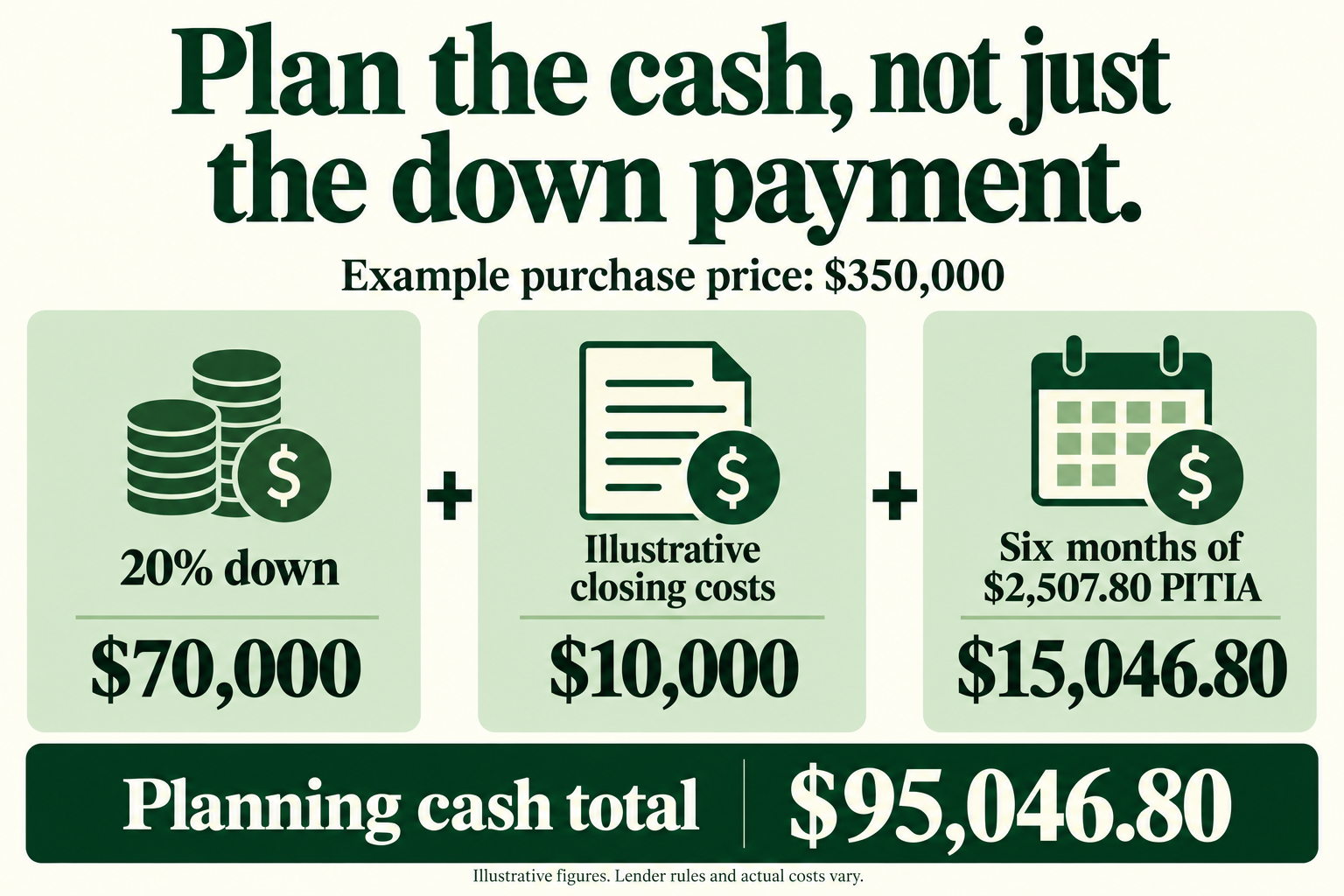
On the $350,000 purchase, combine $70,000 down, an illustrative $10,000 closing-cost allowance and $15,046.80 in six-month planning reserves. The total is $95,046.80. The $10,000 is a placeholder for this example; replace it with a written cost estimate and the actual treatment of deposits, credits and prepaid items.
If you have $90,000 available, you are $5,046.80 short of this planning total, despite having more than the down payment. That gap might require a price adjustment, a different program or more verified cash. An income ratio doesn’t fund it.
Check which balances the lender accepts and whether it discounts retirement or investment accounts. Asset value can move, and withdrawal rules can matter. Don’t assume an available credit line, a gift or expected refinance proceeds qualify as reserves without a written answer. Keep your own repair reserve beyond the underwriting minimum where the property’s condition warrants it.
Leases and appraiser-supported rent
An executed lease documents the agreed rent; an appraiser’s rent schedule supports a market-rent estimate. A lender may require both, select the lower supported amount or apply another program-specific approach. Ask which evidence it accepts for an occupied property, vacant purchase or refinance.
Form 1007 is the Single-Family Comparable Rent Schedule. Seeing that form in a file doesn’t mean the lender automatically accepts your preferred rental figure. Review discrepancies between the lease, appraisal and the revenue used in the quote.
Suppose the lease says $3,200 but the accepted market-rent figure is $2,950. If the lender uses $2,950 and PITIA is $2,507.80, rent-based DSCR falls from about 1.28 to 1.18. A $250 monthly difference can change the file’s coverage category. Get the income figure confirmed before relying on a preliminary estimate.
For an existing tenancy, prepare the complete signed lease, relevant amendments and the payment evidence the lender requests. Explain concessions or included utilities. A headline lease amount may not represent what the tenant consistently pays or what the owner keeps.
Short-term rentals need their own review. Confirm whether the program accepts historical booking revenue, appraisal-supported long-term rent or a third-party projection. Keep your operating analysis annual and account for seasonal vacancy and service costs. A revenue estimate from an Airbnb data service isn’t automatically qualifying income.
Property eligibility
Confirm the property type and location before paying for an appraisal. Residential rental programs often focus on investment homes and small residential properties, while larger apartment buildings, mixed-use buildings and other commercial assets may use a different lending product. A favorable DSCR doesn’t override a property restriction.
Give the lender the unit count, rental strategy and condition, including any planned work. A stabilized rental and a building needing major rehabilitation are different financing cases. Ask whether the property must be habitable and rent-ready at closing, and what happens if the appraisal identifies required repairs.
For a condominium, ask about project eligibility and association costs. For a short-term rental, confirm the program accepts that use and investigate the property’s actual operating permissions. A loan approval doesn’t grant a local rental license or change association restrictions.
Order an insurance estimate early. The $150 monthly insurance assumption in this article is an example, not a local premium forecast. If your actual cost is materially higher, update both PITIA and the operating budget in their respective calculations. Avoid subtracting the same expense twice within one method.
Tell the lender about additional units, accessory structures and unusual features. Listing descriptions aren’t enough to establish permitted use or lender eligibility. For a commercial transaction, request the commercial program’s own NOI, appraisal, property-condition and borrower requirements rather than importing residential rules.
LLCs and borrower documents
Some DSCR lenders permit individual borrowers; others require an LLC or similar entity. The right ownership structure must fit the selected lender and transaction. It can also require personal guarantees, so entity borrowing should never be described as automatically removing personal repayment responsibility.
Lima One’s public rental FAQ requires an LLC or similar entity. Visio’s process materials describe entity requirements that vary by property location and discuss personal guarantees. Confirm your own program before changing the buyer name or property ownership.
Prepare formation documents, an operating agreement or equivalent ownership documents, and evidence of signing authority when requested. The purchase contract, title vesting and loan documents need consistent names. Resolve discrepancies with the lender and closing professionals early.
An entity document alone doesn’t establish that a person can sign for every owner. Ask which members must provide information or guarantees and whether the entity needs to be registered in the property’s state. Get legal or tax questions about the structure reviewed by an appropriately qualified professional; a DSCR article cannot decide those consequences for you.
First-time investors
First-time rental investors can be eligible under some DSCR programs. Lima One’s rental page explicitly advertises no minimum investment experience. Other lenders may apply experience conditions or different terms, so confirm the rule instead of assuming all programs accept the same borrower profile.
Be precise about what “first-time” means. A first-time landlord, first-time homebuyer and experienced homeowner buying an initial rental aren’t identical files. Give the lender the actual housing and investment history it asks for.
Your own preparation matters even where prior rental ownership isn’t required. Build a vacancy plan, a repair budget and a way to manage collections and tenant turnover. Include a management allowance if you may need professional help. Leaving it out can make the first property look easier to carry than it will be.
Ask how future acquisitions affect reserve checks. Money used to complete the first purchase is no longer available for the next. Track cash remaining after each closing and the ongoing obligations of the properties you already own.
DSCR loans versus conventional investment mortgages
Conventional investment financing can use rental income while still evaluating the borrower’s income and debt-to-income ratio. DSCR programs focus on property coverage under their own rules. A conventional loan isn’t automatically unavailable to a self-employed investor, and a DSCR loan doesn’t eliminate credit or asset documentation.
Fannie Mae’s subject-property rental guidance, updated September 2, 2026, applies a 75% adjustment to gross rent for its purchase calculation and subtracts PITIA. It also distinguishes how rental income can be used according to management experience. This is a conventional qualifying-income calculation, not the same test as simply dividing gross rent by PITIA.
For the example’s $3,200 rent, 75% is $2,400. Subtract $2,507.80 PITIA and the result is -$107.80 monthly. That arithmetic explains why “the rent covers the payment” isn’t enough to infer how a conventional file will qualify. The lender still applies the applicable rules to the entire application.
Compare documentation, total financing costs and exit plans for each available option. Personal income flexibility may be valuable, but it doesn’t justify ignoring a costly prepayment provision or weak operating cash flow. Request written terms for both options if you can qualify for them.
Test your property in the DSCR calculator
Debt Service Coverage Ratio = net operating income ÷ annual debt service.
Same property, two DSCR methods
Operating budget
—Annual NOI ÷ annual principal and interest
Lender method estimate
—Qualifying monthly rent ÷ PITIA
PITIA includes principal, interest, taxes, insurance and association dues. Non-monthly debt payments are annualized and divided by 12. The operating result uses your total expenses, including vacancy and management only when entered or included in the estimate. Cash flow is before capital replacements, repair reserves and income tax. Neither ratio confirms loan approval; lender rules vary.
- Net operating income
- —
- per year
- Annual debt service
- —
- per year
- Net cash flow
- —
- per year
- Max loan at target DSCR
- —
Sensitivity
| Loan amount, interest rate | −2% | Your rate | +2% |
|---|---|---|---|
| Loan −10% | — | — | — |
| Your loan | — | — | — |
| Loan +10% | — | — | — |
Note. Results are informational estimates only and do not constitute financial advice or a loan offer. Balloon payments, blended portfolios and lender-specific requirements are not modeled. Confirm qualification with your lender.
The calculator above estimates NOI-based coverage. It isn’t a credit checker, loan prequalification tool or approval-likelihood score. It doesn’t save a verified underwriting profile or connect to a lender’s pricing system.
For the worked example, enter $38,400 annual income, $13,320 annual deductions including the vacancy allowance, a $280,000 loan, 7.5% interest and 30 years. Expected coverage is approximately 1.07. Include vacancy once, and keep the $11,400 operating costs consistent with the example.
Change the rate or loan balance to see the mathematical effect. Save a calculation summary for your own comparison, then separately record the lender’s accepted rent, PITIA, credit and cash requirements. A shared or saved calculator result remains an estimate.
Your preparation checklist
Use this as a readiness worksheet, not a pass-or-fail quiz. Mark an item complete only when you have the evidence or a lender-specific answer. Keep sensitive documents in the lender’s secure process; don’t post account balances, identity documents or credit reports in public comments. Use the document checklist and downloadable underwriting workbook to organize the supporting file.
- Confirm investment use, property type and location with the lender.
- Record the requested loan, purchase price or accepted refinance value, and permitted LTV.
- Ask which credit profile and adverse-event rules apply to your guarantors.
- Obtain accepted rental evidence and the lender’s calculation method.
- Calculate coverage using the accepted income and full modeled payment.
- Obtain a written closing-cost estimate and count your deposit or credits correctly.
- Confirm reserve months, eligible assets and funds remaining after closing.
- Prepare borrower or entity documents and signing authority.
- Review term, amortization, rate adjustments, points and prepayment provisions.
- Test a weaker-income operating budget and identify how you would fund repairs.
Write down unresolved items and the date of each quote. Recheck the worksheet when credit, rent, insurance costs or available cash changes. A complete set of answers is more useful than an unsupported percentage chance of approval.
Frequently asked questions
Can I qualify for a DSCR loan without W-2 income?
Some DSCR programs don’t require personal income qualification in the way conventional mortgages do. You still need to satisfy the lender’s credit, asset, property and documentation rules. Confirm the required file rather than treating “no W-2” as “no documents.”
Is 20% down always enough?
No. Twenty percent corresponds to 80% financing when price and accepted value match, but the program may permit less financing or the appraisal may be lower. Closing costs and reserves also require cash beyond the down payment.
How many months of reserves do I need?
Ask the specific lender. Six months is one published lender example discussed above; it isn’t a universal DSCR rule. Confirm the payment basis, eligible account balances and whether other properties increase the requirement.
Does a 1.25 DSCR guarantee approval?
No. The lender must use its accepted income and formula, then review the rest of the file. Credit, valuation, eligible use, cash and other conditions can still prevent approval.
Can I live in the property financed by a rental DSCR loan?
Investment-use rental programs should not be assumed to permit owner occupancy. Tell the lender how you intend to use the property. If you plan to live there, request a financing product explicitly suitable for that use.
Can I buy through a new LLC?
It depends on the lender’s entity and borrower requirements. Ask about formation documents, ownership, guarantees and signing authority before you put the entity on the contract. A new entity doesn’t bypass the review of the people behind it.
What should I do before paying application costs?
Get a preliminary review of property eligibility, credit, accepted rent, LTV and cash requirements. Ask which fees are refundable and when they become due. That review can identify a mismatch early, although it isn’t a final approval.
Next step: use the main DSCR calculator to organize the property math, then compare it with a lender’s written requirements. Keep the operating budget and underwriting file side by side.
Leave a Reply