

Sources checked October 14, 2026. Linked lender and agency guidance can change. Confirm current eligibility and terms directly before making a financing decision.
An Airbnb DSCR loan can finance an eligible investment property using a lender’s accepted rental-income calculation. To screen the investment yourself, estimate revenue from booked nights, subtract a complete operating budget, and divide net operating income by debt service. A lender may instead use qualifying monthly rent divided by PITIA. Confirm its method before comparing ratios.
A busy calendar isn’t proof of strong coverage. Cleaning, management, utilities and seasonal gaps can consume revenue that looks impressive on a listing dashboard. Your operating budget and the lender’s qualifying-income figure deserve separate attention.
This guide explains how to use a DSCR calculator for short-term rental analysis, compare income evidence and test an off-season. All property examples are hypothetical. Lender and documentation references were reviewed on October 13, 2026; the 7.5% rate used below is a calculation assumption, not a current market average or loan offer. Start with our DSCR loan guide if you need the financing basics.
In this guide
- How lenders calculate STR coverage
- Actual income, AirDNA and appraisal rent
- Why a 20% haircut is not universal
- ADR and occupancy worked example
- Test the figures in the calculator
- Seasonality and cash reserves
- Compare financing programs
- Hypothetical $85,000 cabin scenario
- Documents and questions for your lender
- Frequently asked questions
How lenders calculate STR coverage
Lenders don’t all calculate short-term rental coverage the same way. Ask which revenue source they accept, what adjustments they apply, and which payment components enter the denominator. An annual NOI analysis measures a different income margin from a residential rent-to-PITIA calculation, even when both are called DSCR.
For your own operating analysis, the formula is DSCR = annual net operating income / annual debt service. Annual NOI is revenue after operating expenses and any vacancy or collection allowance not already reflected in the revenue forecast. Annual debt service here means scheduled principal and interest.
Residential underwriting can instead compare accepted monthly rental income with principal, interest, property taxes, insurance and association dues: PITIA. The lender may apply its own revenue adjustment before making that comparison. Don’t insert your preferred gross revenue into the numerator without checking the program.
Use matching periods. Monthly income divided by annual debt payments gives a meaningless result. Annual income divided by annual payments works; monthly income divided by monthly payments also works if the income treatment is consistent.
Why one property can show two ratios
Consider a $350,000 property financed with 20% down and a $280,000 loan. At an illustrative 7.5% rate over 30 years, monthly principal and interest are approximately $1,957.80. Add $400 monthly taxes and $150 insurance, with no association dues, and PITIA is approximately $2,507.80.
If an accepted long-term rent is $3,200 monthly, rent divided by PITIA is about 1.28. An operating budget with $38,400 gross annual rent, 5% vacancy and $11,400 expenses produces $25,080 NOI. Divide that by roughly $23,493.61 annual principal and interest and NOI-based DSCR is 1.07.
Neither result proves an STR program accepts $3,200 or approves the loan. The example shows why you must establish the income source and calculation method first. Our step-by-step DSCR formula guide explains the expense treatment.
Actual income, AirDNA and appraisal rent
An STR lender may examine operating history, projected revenue or appraiser-supported rental income, subject to its program. These sources answer different questions. Actual statements show past collections, a forecast estimates future performance, and a rent schedule supports a rental assumption. None automatically replaces the lender’s own review.
| Evidence | What it helps establish | What to check |
|---|---|---|
| Historical bookings and payments | Revenue actually generated over a stated period | Refunds, fees, owner stays and whether all channels are included |
| AirDNA or another projection | Estimated performance from modeled data | Comparable properties, availability, included charges and lender acceptance |
| Appraiser-supported rent | A rental estimate for the property | Whether it reflects long-term rent or an accepted STR approach |
| Manager’s operating records | Collections and recurring operating costs | Gross versus net figures, owner charges and reconciliation to deposits |
Actual operating history
Use a full-year view where available. A statement from the busiest quarter cannot explain the income available through the rest of the year. Export records from every booking channel and direct-booking system used by the property, then reconcile them with the reporting period.
Separate room charges, guest-paid cleaning, refunds, taxes collected for authorities and platform deductions. A booking confirmation and a bank deposit can show different amounts. You need to know why before entering either in the calculator.
If you’re buying an existing operation, ask what transfers with the property. Don’t assume the seller’s reviews, booking pipeline, management arrangement or account history will become yours. Future performance can change even when the house and furniture stay the same.
AirDNA DSCR underwriting
AirDNA data can support a research process, but lender acceptance is a separate decision. Its methodology explains that revenue can be estimated from booked days and average daily rate, and that availability affects the occupancy denominator. Its published revenue description includes cleaning fees. Check the exact report’s definitions before importing its figures.
Look at comparable size, guest capacity, amenities and location. A cabin with a hot tub and a strong established listing may not be a useful match for an unfurnished purchase needing repairs. Compare the assumptions, not just a headline annual total.
Record the report date and keep the original file. Ask the lender which product or report it accepts, what supporting evidence is needed, and whether the accepted forecast is reduced or capped. The phrase “AirDNA DSCR underwriting” doesn’t mean every projection is approved.
Our calculator has no AirDNA connection. You can manually enter a supported annual estimate after checking it, but the tool doesn’t retrieve, validate or certify a forecast.
Appraisal rent and Form 1007
Form 1007 is the Single-Family Comparable Rent Schedule. The rent supported by an appraisal may differ from projected nightly revenue. Ask the lender whether its STR program uses long-term market rent, STR evidence or a specified comparison between them.
If projected STR revenue looks strong but the lender uses long-term rent, the qualifying result can be lower than expected. That doesn’t make either figure interchangeable with your actual operating NOI. Keep the lender’s accepted rent beside the operating budget.
You don’t need to guess which document controls. Ask before paying for the appraisal, then review the final accepted figure. For the broader file, see our DSCR loan requirements guide.
Why a 20% haircut is not universal
There is no universal rule that every STR lender credits exactly 80% of revenue. A program can use a percentage adjustment, another income source, a cap or a different method. Obtain the actual rule for your lender and transaction rather than treating a sample haircut as an industry standard.
Here’s a calculation to understand the effect. Assume $60,000 annual gross revenue, $2,500 monthly PITIA and a hypothetical program that credits 80% of that revenue. Accepted monthly income would be $60,000 × 80% / 12 = $4,000. Dividing $4,000 by $2,500 produces 1.60 rent-based coverage.
That is an underwriting illustration. It doesn’t establish that the property produces $48,000 NOI. If actual operating expenses are $30,000, NOI is $30,000 before debt service. A percentage adjustment cannot replace a complete cash-flow budget.
Keep adjustments in the correct calculation. Don’t subtract a lender haircut from an already adjusted income figure simply because it seems more conservative. And don’t assume the haircut captures every cost you will incur. Document what has already been deducted.
Conventional STR income uses different rules
Fannie Mae’s short-term rental guidance, dated September 2, 2026, applies to eligible one-unit investment properties. For purchases, it uses accepted market rental evidence, applies a 50% adjustment and subtracts PITIA. The positive result can offset the payment under that guidance; the calculation is not a DSCR-loan approval test.
With an illustrative accepted monthly rental figure of $5,000 and $2,500 PITIA, that calculation is $5,000 × 50% – $2,500 = $0. It would be misleading to substitute a private lender’s hypothetical 80% factor into the conventional formula. Ask the conventional lender to apply its actual policy to the whole file.
Conventional financing should not be dismissed simply because you plan a vacation rental. It has its own documentation and eligibility rules. Compare real quotes and qualifying calculations rather than assuming one product always gives more financing.
ADR and occupancy worked example
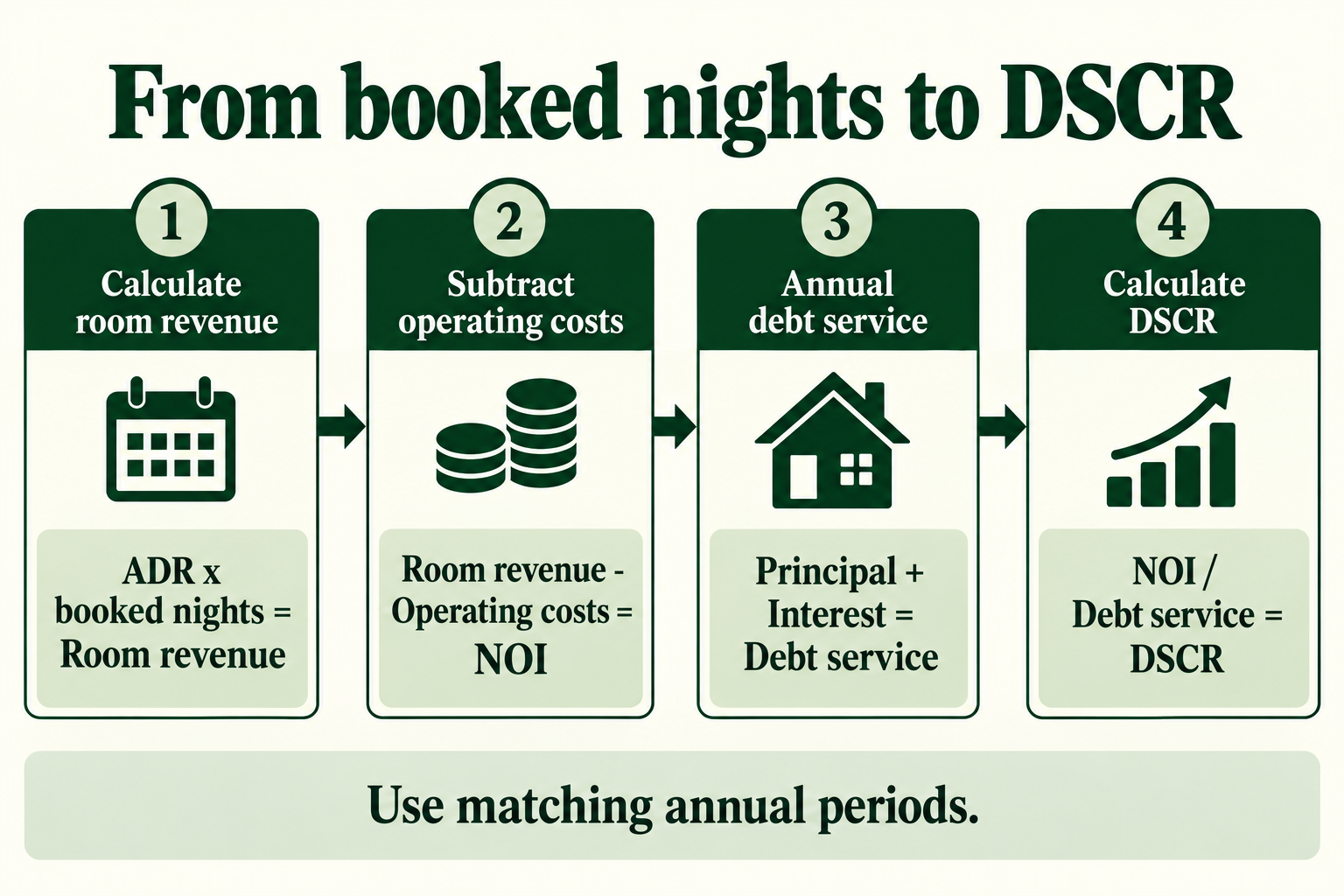
Average daily rate, or ADR, is the average rate per booked night under the definition you select. For a room-revenue planning model, annual room revenue = ADR × available nights × occupancy. Use occupancy as a decimal, and keep cleaning charges and other income separate unless your ADR already includes them.
Assume $225 room-only ADR, 365 available nights and 60% occupancy. Expected booked nights are 365 × 0.60 = 219. Multiply 219 by $225 and annual room revenue is $49,275.
The forecast already accounts for unbooked nights through occupancy. Don’t subtract a second 40% vacancy allowance from the resulting room revenue. If you use an additional collection-loss assumption, explain it separately and avoid counting the same risk twice.
Build the operating budget
The following expenses are illustrative assumptions, not market averages. Management is 20% of room revenue and the modeled platform cost is 3%. Actual contracts and platform fee structures can differ, so replace both with your own figures.
| Annual expense | Assumption | Amount |
|---|---|---|
| Management | 20% of $49,275 | $9,855.00 |
| Platform cost | 3% of $49,275 | $1,478.25 |
| Property taxes | Fixed annual budget | $4,200.00 |
| Insurance | Fixed annual budget | $1,800.00 |
| Utilities and internet | Fixed annual budget | $2,400.00 |
| Maintenance and supplies | Annual operating budget | $1,600.00 |
| Total operating costs | Variable plus fixed costs | $21,333.25 |
This simplified example assumes guest cleaning charges exactly offset cleaning costs and includes neither in the displayed room-only revenue or expenses. Real cleaning margins may be positive or negative. If you add cleaning income, also add the related cost once. Handle furniture replacement and major capital work in your cash plan even if they sit outside NOI.
Subtract $21,333.25 from $49,275 to get $27,941.75 NOI. With the example’s $280,000 loan, annual principal and interest are approximately $23,493.61. NOI-based coverage is $27,941.75 / $23,493.61 = 1.19 DSCR, rounded.
Find the occupancy needed for your target
With $225 ADR, 365 available nights, 23% variable expenses and $10,000 fixed operating costs, NOI equals room revenue × 77% – $10,000. To target 1.25 coverage, required NOI is $23,493.61 × 1.25 = approximately $29,367.01.
Required room revenue is therefore ($29,367.01 + $10,000) / 77% = approximately $51,126. Divide that by $225 × 365 and required occupancy is about 62.3%. This is a mathematical threshold under the stated budget, not evidence that the market supports those bookings.
The calculation helps you ask a better question: can this specific property sustain that annual occupancy at the modeled rate and expense structure? Increasing ADR can reduce bookings; changing occupancy can affect turnover costs. Treat those inputs as connected assumptions.
Test the figures in the calculator
Debt Service Coverage Ratio = net operating income ÷ annual debt service.
Same property, two DSCR methods
Operating budget
—Annual NOI ÷ annual principal and interest
Lender method estimate
—Qualifying monthly rent ÷ PITIA
PITIA includes principal, interest, taxes, insurance and association dues. Non-monthly debt payments are annualized and divided by 12. The operating result uses your total expenses, including vacancy and management only when entered or included in the estimate. Cash flow is before capital replacements, repair reserves and income tax. Neither ratio confirms loan approval; lender rules vary.
- Net operating income
- —
- per year
- Annual debt service
- —
- per year
- Net cash flow
- —
- per year
- Max loan at target DSCR
- —
Sensitivity
| Loan amount, interest rate | −2% | Your rate | +2% |
|---|---|---|---|
| Loan −10% | — | — | — |
| Your loan | — | — | — |
| Loan +10% | — | — | — |
Note. Results are informational estimates only and do not constitute financial advice or a loan offer. Balloon payments, blended portfolios and lender-specific requirements are not modeled. Confirm qualification with your lender.
The calculator above uses annual income, annual operating expenses and loan terms. It doesn’t offer dedicated ADR and occupancy fields or a monthly-lease toggle. Calculate annual revenue with the worksheet above, then enter the figures manually to compare an STR budget with a long-term rental budget.
For the STR example, enter $49,275 income, $21,333.25 expenses, a $280,000 loan, 7.5% interest and 30 years. Expected DSCR is approximately 1.19. Choose the short-term rental preset if useful, but enter your complete expenses so an estimated percentage doesn’t replace your budget.
To compare a standard lease, use that lease’s annual rent and its own vacancy and operating costs. Don’t keep STR cleaning, utilities and management assumptions unchanged unless the contracts genuinely require them under the lease strategy.
Save or copy separate calculation summaries for each scenario. The tool doesn’t save a verified lender qualification profile or assess your credit. Its colored coverage bands are planning indicators, not approval decisions.
Seasonality and cash reserves
Annual revenue can hide months when collections don’t cover the bills. Debt payments continue during the off-season, as do insurance and many utilities. Build a monthly cash schedule before deciding that an annual ratio provides enough protection.
Consider the same $225 ADR across a 365-day planning year, with 120 peak-season nights at 80% occupancy and 245 other nights at 45%. Expected bookings are 96 plus 110.25 nights. Fractional nights are acceptable forecast averages, not individual bookings. Total modeled room revenue is $46,406.25.
That is below the flat 60%-occupancy forecast of $49,275. Applying the same 23% variable expense rate and $10,000 fixed costs leaves about $25,732.81 NOI. Coverage falls to approximately 1.10. The annual average becomes more useful when you can explain the seasonal inputs behind it.
Run a weaker year
At $225 ADR and 45% occupancy across all 365 available nights, room revenue is $36,956.25. Under the same expense assumptions, NOI becomes about $18,456.31. Divide by $23,493.61 debt service and coverage is approximately 0.79.
If ADR also falls to $200 at 45% occupancy, revenue is $32,850 and NOI is $15,294. Coverage is approximately 0.65. Those figures don’t predict a downturn. They show the funding gap you would need to manage if the assumptions occurred.
| Room-only scenario | Annual revenue | NOI | Rounded DSCR |
|---|---|---|---|
| $225 ADR, 60% occupancy | $49,275.00 | $27,941.75 | 1.19 |
| Seasonal model described above | $46,406.25 | $25,732.81 | 1.10 |
| $225 ADR, 45% occupancy | $36,956.25 | $18,456.31 | 0.79 |
| $200 ADR, 45% occupancy | $32,850.00 | $15,294.00 | 0.65 |
A lender’s reserve requirement is separate from your chosen operating cushion. Ask what payment basis and assets its reserve test accepts. Then consider the property’s repairs, seasonal deficits and startup period. Our requirements guide’s reserve section explains the distinction between closing funds and reserves.
Compare financing programs
Compare programs by accepted income evidence, property use, cash requirements and total financing terms. A “top lender” label doesn’t tell you whether your cabin, condominium or new operation fits the program. Request a scenario review before paying nonrefundable costs.
Two published STR examples show why details matter. Lima One’s rental page lists a short-term rental program with up to 75% purchase LTV and up to 70% cash-out LTV. Visio advertises vacation-rental financing in its public DSCR materials. Confirm each lender’s current income method and your property’s eligibility; these examples are not rankings or endorsements.
For a $350,000 value, 75% financing means a $262,500 loan and $87,500 toward the purchase price before fees. If your planning budget assumed 80% financing, the cash difference is $17,500. A program’s lower LTV can matter more than a small advertised rate difference.
Compare quoted rate, points, amortization, reserve requirements and the cost of exiting early. Ask about prepayment provisions if you expect to refinance after building a rental history. An interest-only period can improve current coverage while leaving a higher future repayment burden.
Hypothetical $85,000 cabin scenario
Imagine a fictional cabin with $85,000 annual room revenue, 25% variable operating costs and $18,000 fixed operating expenses. These inputs are educational assumptions, not a verified Smoky Mountains listing, local forecast or client case study. No actual sale or lender approval is being claimed.
Variable costs are $21,250. Subtract those and $18,000 fixed costs from $85,000 to get $45,750 NOI. At $23,493.61 annual debt service, coverage is approximately 1.95, with $22,256.39 remaining after modeled debt payments.
Now reduce room revenue by 25% to $63,750, keeping the 25% variable-cost structure and $18,000 fixed costs. NOI becomes $29,812.50 and coverage drops to about 1.27. Gross revenue falls 25%, but NOI falls more sharply because fixed costs remain.
At $50,000 room revenue, NOI is $19,500 and coverage is approximately 0.83. That weaker case matters if the purchase depends on aggressive peak-season assumptions. Review the coverage benchmarks guide to understand what each ratio says about the modeled cushion.
Revenue alone doesn’t establish a sensible purchase price or cash return. This example keeps loan terms fixed so you can see the effect of operating income. It excludes furnishing costs, major replacements, closing costs and tax consequences; include those in a separate investment budget.
Documents and questions for your lender
Prepare a consistent file before requesting vacation rental DSCR financing. If one document shows room revenue and another includes cleaning or collected taxes, explain the difference rather than handing over inconsistent totals.
- Provide available booking history, payment records and management statements for the requested period.
- Label the source and date of forecasts, with occupancy and availability definitions.
- Identify property type, unit count, intended use and any association restrictions.
- Confirm required borrower credit, funds to close, reserves and entity documents.
- Ask which rent evidence, revenue adjustment and DSCR formula will qualify the loan.
- Request the actual costs, payment structure and prepayment terms in writing.
Check legal operating permissions with the appropriate local authority and association before committing to the strategy. A rental projection or loan approval doesn’t establish permission to operate. Rules are specific to the property and can change, so a generic destination-level statement isn’t enough.
Keep assumptions dated. If insurance, available nights or a management contract changes, update both the operating model and any affected underwriting figure. Don’t quietly retain the earlier ratio while changing the costs it was based on.
Frequently asked questions
Can I get a DSCR loan for Airbnb without rental history?
Some programs consider qualifying projections or appraiser-supported income, while others require a particular operating history or use another rental figure. Confirm the exact program before assuming an unseasoned property qualifies. A projection isn’t proof of future collections.
Do all lenders use 80% of AirDNA revenue?
No. There is no universal AirDNA percentage for STR DSCR lending. Ask which report the lender accepts and whether it uses a reduction, a cap, actual history or appraisal rent instead.
Should I subtract vacancy after multiplying ADR by occupancy?
Occupancy already accounts for unbooked available nights in that forecast. Don’t subtract the same vacancy again. Document any separate collection loss or downtime adjustment so it doesn’t duplicate the occupancy assumption.
Are cleaning fees income or an expense?
Guest cleaning charges can be income while the cleaner’s charge is an expense. Keep both entries consistent with the revenue source. If a report already includes cleaning income, don’t add it again; if costs exceed the charge, the shortfall affects NOI.
Does the short-term rental preset connect to Airbnb?
No. It is an editable expense illustration, and the calculator doesn’t import Airbnb bookings or AirDNA data. Enter and verify your own annual figures, then compare them with the lender’s accepted calculation.
What DSCR should I target for a vacation rental?
Choose a planning target with realistic expenses and test seasonal and lower-revenue cases. The lender’s minimum is program-specific. A higher modeled ratio is useful only when its income assumptions and cash reserves are credible.
Can a strong Airbnb forecast guarantee financing?
No. Property eligibility, borrower credit, accepted income evidence, appraisal, reserves and the rest of the file still matter. A calculator estimates coverage; it doesn’t issue a financing decision.
Next step: build the annual room-revenue forecast, reconcile the fees, and run the DSCR calculator with a complete expense budget. Save a base case and a weaker year before comparing written lender terms.
Leave a Reply