
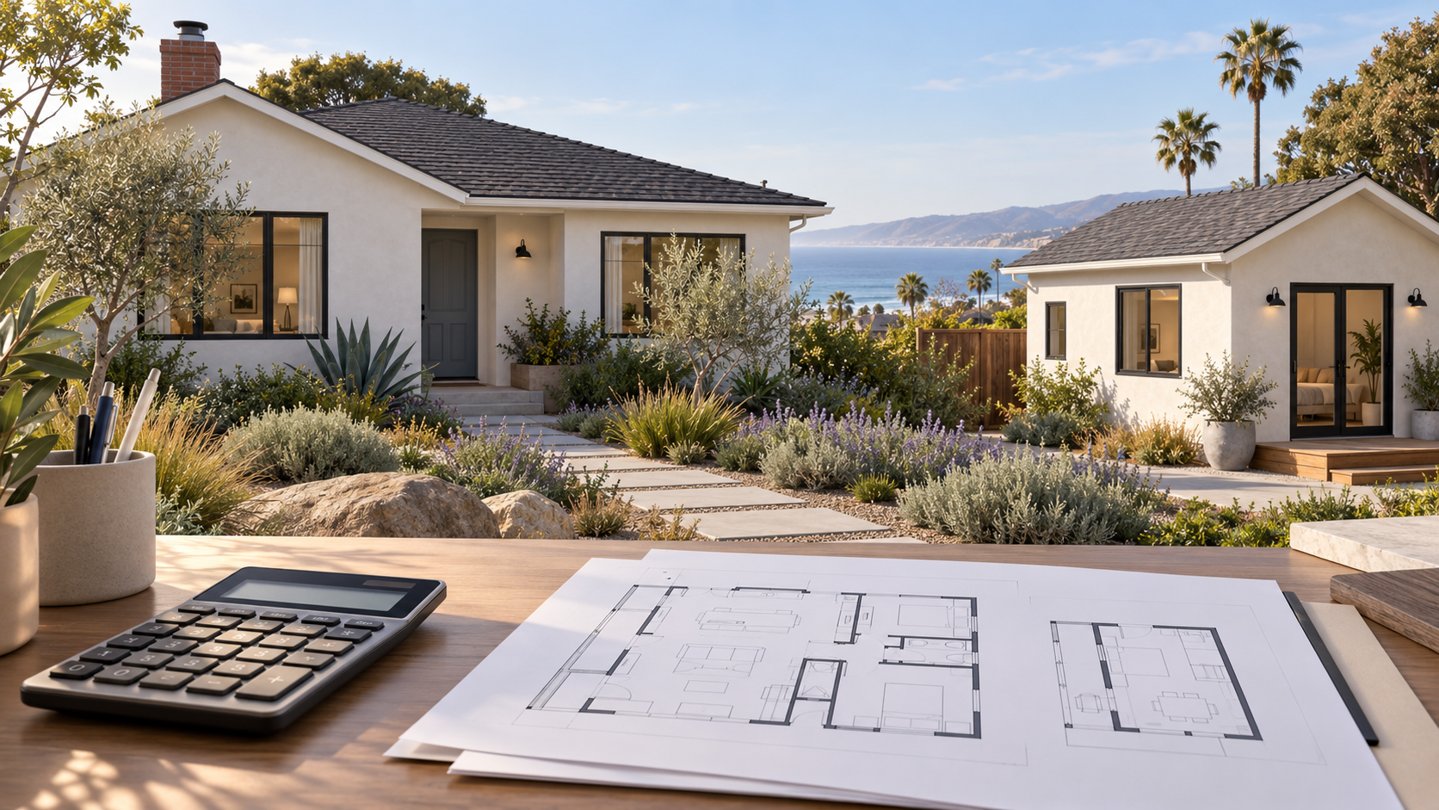
A DSCR loan in California can qualify a rental property primarily through its income rather than a conventional personal debt-to-income test. In high-price markets, the difficult part is often the payment: supported rent may cover interest, taxes and insurance while falling short of a fully amortizing mortgage. An accessory dwelling unit can help only if the lender accepts its rent and the property meets program rules.
Start with the income the lender will actually use, then compare an amortizing payment, an interest-only period and the payment after that period ends. A sub-1.00x or no-ratio program may offer a financing path, but it doesn't make a monthly operating deficit disappear. The calculator below keeps qualification and ownership cash flow separate.
By Maniteja, Investor. Research checked October 29, 2026. This is educational analysis, not a loan offer, legal opinion or record of a client transaction. Rates, rents and property examples are hypothetical unless explicitly attributed to a source. DSCR Calculator Pro is not the lender.
California DSCR loans: a practical starting point
For a purchase, collect the proposed loan terms, appraised market rent, existing leases, buyer tax estimate and landlord insurance quote. If there is an ADU, add the permit and completion records, unit description and evidence supporting its separate rent. Use our DSCR loan guide for the general qualification process before applying the California-specific checks here.
California High-Value Property & ADU Income Modeler
All defaults are hypothetical. Enter verified figures. This is an educational scenario model, not a lender, zoning decision or tax assessment. No live parcel, permit or pricing database is connected.
Save/Load stores one scenario in this browser. CSV export contains values only, without Excel formulas. Data is not sent to us by this tool. Capital replacements, income tax, closing costs and lender-specific adjustments are excluded. Do not enter personal or tenant information.
The California cap-rate dilemma: price, rent and operating costs
A high purchase price relative to rent leaves less room for debt service. That is a property-level arithmetic problem, not proof that every Los Angeles or Bay Area rental has weak cash flow. Compare the actual unit's supported rent and expenses with the financing available to you. Expected appreciation is a separate assumption and cannot be used to pay a current shortfall.
For scale, a hypothetical $350,000 purchase with 20% down creates a $280,000 loan. At a 7.50% illustrative rate over 30 years, principal and interest is $1,957.80 monthly. At $3,200 rent, the rent-to-principal-and-interest ratio appears comfortable. Add taxes, insurance and association dues before calling that a residential DSCR result. Then account for vacancy, repairs and management before calling it a profitable rental.
Cap rate is annual NOI divided by the price or value basis you specify. Gross scheduled rent minus vacancy and collection loss equals effective gross income, or EGI. EGI minus operating expenses equals NOI. Operating DSCR is annual NOI divided by annual principal and interest. Taxes and insurance belong in operating expenses under that method.
Many residential DSCR programs instead compare monthly accepted rent with PITIA: principal, interest, taxes, insurance and association dues. That ratio usually does not deduct every ownership expense in the numerator. Do not subtract taxes and insurance from NOI and then include them again in the debt-service denominator. Our rental-property DSCR calculation guide explains both conventions.
The price-to-rent relationship also changes how useful a small rent adjustment is. Another $200 of monthly rent can be meaningful, but a loan sized around several thousand dollars of unsupported ADU revenue is a different proposition. Identify the source of each rent figure and test a lower amount before paying for an appraisal or rate lock.
Interest-only DSCR loans: initial relief and the later payment
An interest-only period reduces the initial required payment because principal is not being repaid. It can improve the lender's qualifying ratio if that program qualifies at the interest-only payment. Ask directly: some programs apply another payment or stress rule. A product name alone doesn't establish the qualifying denominator.
For an $825,000 balance at an illustrative fixed 7.50%, monthly interest is $5,156.25. The fully amortizing 30-year payment at that same rate is $5,768.52. The initial difference is $612.27 monthly. That is payment relief, not forgiven debt or a reduction in the principal you owe.
If a hypothetical 30-year loan has ten interest-only years followed by 20 amortizing years, and the rate remains 7.50%, the later payment is $6,646.14. The balance remains $825,000 at the end of the interest-only period if no principal is paid. Compared with the original interest-only payment, that is a $1,489.89 monthly increase before any change in taxes or insurance.
| Same illustrative $825,000 balance at 7.50% | Monthly principal and interest | Principal treatment |
|---|---|---|
| 30-year amortizing | $5,768.52 | Principal declines through payments |
| Initial interest-only | $5,156.25 | No scheduled principal reduction |
| After 10 IO years; 20 years remaining | $6,646.14 | Original balance amortizes over 20 years |
Some contracts have a different overall term, an adjustable rate, a balloon or other features. The modeler assumes a fixed rate, no principal reduction during the interest-only period, and amortization over the remaining entered term. It is not a representation of every lender's note. Read the payment schedule and ask whether voluntary principal payments change subsequent required payments.
Compare interest-only and amortizing offers at their actual respective rates and fees. The same-rate comparison above isolates the payment mechanics; it does not claim both options are offered at identical pricing. Use our interest-only DSCR guide and prepayment explanation to compare a planned refinance with the cost of staying in the loan.
California sub-1.00x and no-ratio programs: verify the whole file
A residential DSCR below 1.00x means accepted rent is below the payment used in that calculation. A no-ratio program may omit a minimum cash-flow test while relying on other requirements. These categories are not interchangeable, and neither promises approval of a property with negative cash flow.
As checked October 29, 2026, American Heritage Lending's DSCR page advertises a 0.75x minimum in its program summary and interest-only options. Those statements identify topics to discuss with an originator, not terms automatically available for every California borrower. Obtain the current property, credit, LTV and liquidity conditions in writing.
A 720-plus credit score and 25%–30% down-payment figures are useful scenarios to investigate, not California law or universal program requirements. Ask how lower coverage changes the maximum LTV, points, reserves and eligible transaction types. Do not quote an attractive standard-program rate while using a lower-coverage program's qualification rules.
Build a cash-support plan for a deficit. If recurring ownership costs exceed collected rent by $600 monthly, that is $7,200 of annual owner contributions before an unexpected repair. Keep those contributions separate from the down payment and lender reserves. A reserve balance can support a finite period; it doesn't turn the recurring shortfall into income.
Our sub-1.00x and no-ratio guide examines those tradeoffs. A larger down payment may improve coverage, but compare the additional cash committed with the return and liquidity you retain. If your documented personal income supports conventional financing, request a competing estimate rather than assuming a DSCR product must be the cheapest route.
Proposition 13: a framework for taxes, not the seller's bill forever
California's assessment system can make an established taxable-value base relatively predictable, subject to its rules. It does not guarantee that a buyer inherits the seller's low tax bill. Orange County's Proposition 13 explanation describes a base-year framework and inflation adjustments generally limited to 2%, with ownership changes and new construction affecting the calculation.
The California Board of Equalization's supplemental-assessment guidance explains that changes in ownership or completed new construction can produce supplemental bills in addition to the annual bill. Ask the county assessor and closing team for an estimate for your transaction, including a completed ADU. Keep any supplemental bill in the cash budget even if it is not part of the first escrow estimate.
The 2% figure is not a blanket cap on every future tax bill. Different assessments, voter-approved obligations and changes to the taxable property can affect the amount due. For underwriting, use the lender's accepted buyer estimate; for ownership, maintain a separate budget for tax events that may be billed later.
The modeler therefore asks for annual property taxes directly rather than presenting a universal California rate. The $13,200 default in the worked example is a hypothetical input. If your estimate changes by $2,400 annually, monthly PITIA rises by $200 and required rent at a 1.25x target rises by $250. Our tax and insurance stress guide shows how to carry that change through the deal.
ADU rental income: legal space, accepted income and actual cash flow
A legal ADU is not automatically qualifying rent. Underwriting also needs an acceptable property configuration, completion status, appraisal and income method. A permitted but unfinished unit may have future value while producing no accepted current income. An occupied unit still needs a supportable lease and a lender-approved treatment of that income.
California HCD's ADU handbook, updated March 2026, is an official starting point for state-law requirements. Confirm the property's local permits and completion records with the responsible jurisdiction. Do not equate a converted garage, separate electric meter or advertised “guest house” with an approved dwelling.
Ask the lender to identify how it classifies the whole property. A single-family home with an ADU, a duplex and a duplex with additional accessory space are different configurations. Unit count and accessory use can change program eligibility. Our multifamily DSCR guide explains why the number of units matters before you compare loan terms.
Conventional financing is not categorically closed to ADUs. Fannie Mae's ADU guidance describes eligible property and financing options. Consult the current Selling Guide for the exact property and income rules; don't assume a principal-residence ADU provision also applies unchanged to your investment property. A non-QM lender's acceptance can differ and should be documented separately.
The modeler has an editable accepted-ADU percentage. That percentage is your scenario assumption, not a published universal haircut. At $2,000 projected ADU rent and 75% acceptance, qualifying ADU income is $1,500 monthly. If acceptance is zero, the qualifying ratio excludes it. Actual cash flow uses your entered expected ADU rent before the tool applies vacancy and operating allowances, which is why its operating result can differ from qualification.
Include the expense side of the unit. Utilities, maintenance, additional insurance, management and capital replacements can absorb part of the rent. If construction is still planned, budget permits, financing, delay and vacancy separately. The tool is an operating model for entered stabilized income; it doesn't estimate construction costs, a completion date or approval of future rent.
Worked example: a hypothetical $1.1 million coastal duplex
Assume a legal duplex purchase at $1.1 million, 25% down and an $825,000 loan. At the illustrative 7.50% rate, compare a 30-year amortizing payment with the hypothetical ten-year interest-only structure described above. Use total supported rent of $6,800, annual taxes of $13,200, annual insurance of $3,600 and no association dues. No ADU income is included in this duplex example.
Monthly taxes and insurance total $1,400. Amortizing PITIA is $7,168.52, giving residential DSCR of approximately 0.949x. Interest-only PITIA is $6,556.25, giving approximately 1.037x. If the lender's entered target is 1.25x, even the interest-only version needs $8,195.31 monthly qualifying rent. Crossing 1.00x does not mean the file clears 1.25x.
For operations, annual scheduled rent is $81,600. Subtract 5% vacancy ($4,080), management at 8% of collected rent ($6,201.60), repairs of $4,080, taxes of $13,200 and insurance of $3,600. NOI is $50,438.40. Annual interest-only debt service is $61,875, leaving a $11,436.60 deficit before capital replacements and income tax.
At the assumed later amortizing payment, PITIA rises to $8,046.14 and residential DSCR falls to about 0.845x if rent and the other costs stay unchanged. You would need a documented change in the economics, additional cash support or another viable exit. A refinance at a lower rate is a possibility to test, not an outcome to promise.
The ADU modeler's separate default illustrates a main house with $5,000 rent plus a $2,000 ADU. That is a different hypothetical property configuration, not a third unit silently added to this duplex. Keep the unit descriptions consistent across your lease schedule, appraisal, insurance and loan application.
Compare California DSCR proposals on a common basis
Request the same loan balance, accepted rent and expense assumptions from each originator. Ask for the initial payment, qualification payment, payment after interest-only, rate-reset terms if any, points, fees, reserves and prepayment schedule. Our lender comparison guide provides a worksheet for that discussion.
Use the site's dated rate benchmarks for market context. The 7.50% here is a fixed modeling assumption, not a current offer or APR. Before closing, reconcile the final rate and insurance binder with the calculation you originally used; a small late change can matter on a thin-coverage property.
Save a base scenario and export a second snapshot with no accepted ADU rent. Then test the later payment. If the deal depends on full ADU acceptance, an extension of interest-only or future appreciation, identify that dependency explicitly. A property is easier to evaluate when the financing benefit and the operating risk remain visible in the same worksheet.
Test the income source that supports the marginal dollar: For a property with an accessory unit, compare the main-home-only case with the case using separately supported ADU income. The difference shows how much the proposed debt depends on that income being accepted. Keep permitted use, valuation and the lender’s income treatment as separate checkpoints in the financing file.
Frequently asked questions
Can I get a DSCR loan below 1.00x in California?
Some lenders advertise lower-coverage or no-ratio programs, but the full property, credit, equity and reserve requirements vary. A qualifying loan does not eliminate an operating deficit. Obtain the applicable written terms before relying on a particular threshold.
Does every California DSCR lender count ADU rent?
No. Acceptance depends on the program, property configuration, documentation, appraisal and income method. The modeler’s accepted percentage is an assumption you enter, not a verified lender rule or a guarantee that an unfinished or unpermitted unit will count.
What happens after ten interest-only years?
It depends on the note. In the tool’s hypothetical 30-year fixed-rate structure, the unchanged balance amortizes over the remaining 20 years. The required payment rises because principal must then be repaid over a shorter period. An ARM or balloon structure requires a different review.
Does Proposition 13 let me keep the seller’s property-tax bill?
Not automatically. Ownership changes and completed new construction can affect assessed value and create supplemental bills. Obtain a buyer-specific estimate and check any ADU construction with the county assessor rather than carrying forward a seller’s historical tax expense.
Are 720 FICO and 25% down universal California DSCR rules?
No. They are scenarios to investigate, not state-law thresholds. Lower-coverage and interest-only requirements vary by lender, transaction, property and other factors. The modeler does not assess credit eligibility.
Leave a Reply